

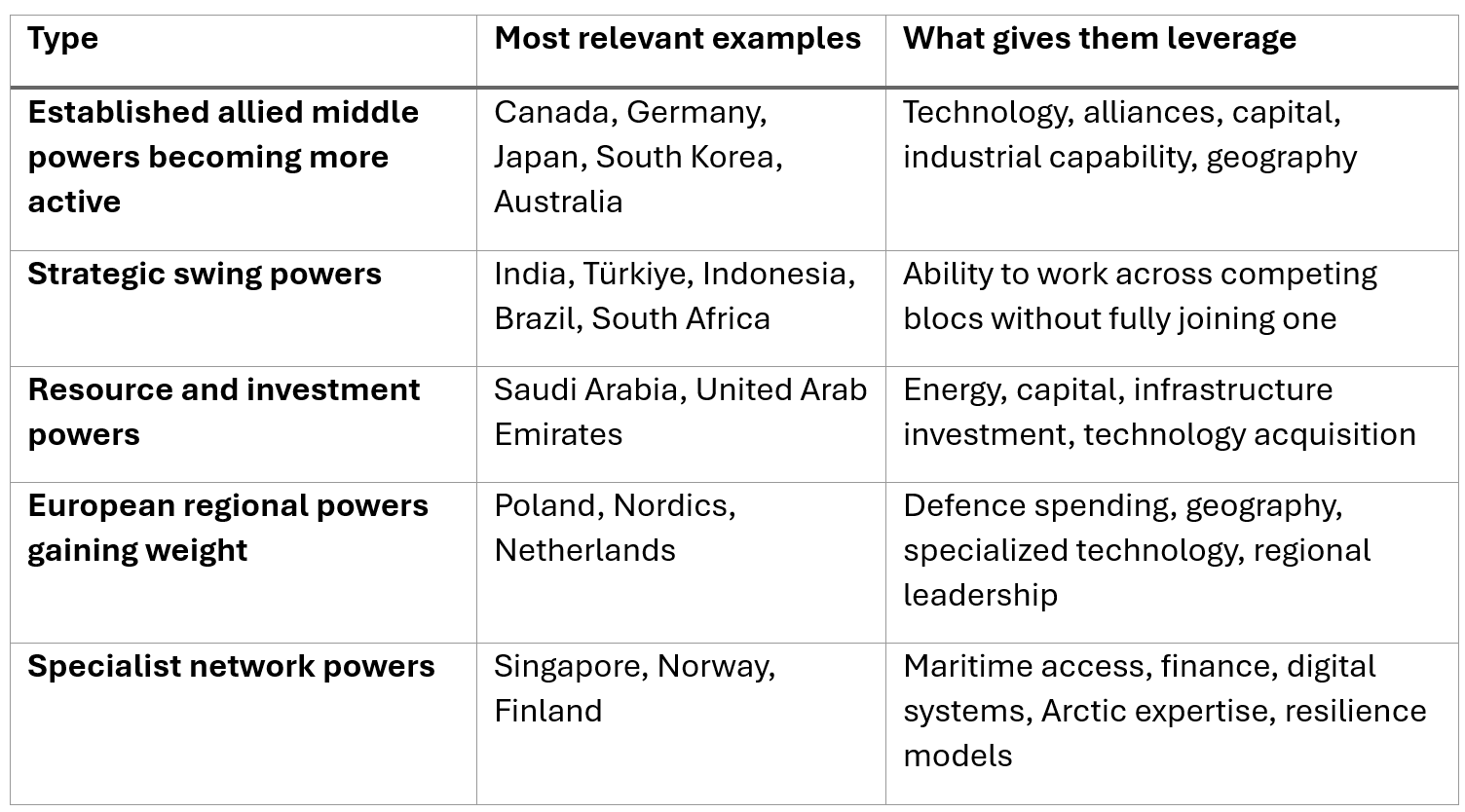
The premise I am taking into next week’s NATO Allied Foresight Conference in Berlin is that future middle powers are not forming a stable “third bloc” between the United States and China. Instead, they are assembling overlapping coalitions around particular dependencies and capabilities, including AI, defence production, critical minerals, energy, space, maritime access, Arctic infrastructure, and supply chains.
Who are the emerging middle powers?
“Emerging” here does not mean developing countries. It means states whose ability and willingness to shape regional or functional systems is increasing.
Emerging patterns
Pattern 1. Small coalitions are replacing broad agreement
Middle powers are forming small groups around specific problems instead of waiting for consensus through NATO, the United Nations, the European Union or the G20.
These groups combine a defined capability need, complementary national contributions, financing, industrial partners and a short path to delivery. Countries join where their interests align and stay outside where they do not.
The result is not a single middle power bloc. It is a shifting set of coalitions built around particular problems.
Pattern 2. Alignment is becoming capability specific
Countries no longer align with the same partners across every domain.
A state may rely on the United States for security, Europe for regulation and industrial access, China for manufacturing, Gulf states for investment and Japan or India for technology.
This is portfolio alignment. The key question is which dependencies it accepts in each area and whether it can change partners when conditions shift.
Pattern 3. Sovereignty is being pooled
Most middle powers cannot control an entire capability system on their own. They are therefore combining selected strengths to preserve freedom of action.
Canada and Germany illustrate this model. Canada contributes resources, Arctic geography, AI expertise and selected defence capabilities. Germany contributes industrial scale, capital, European market access and advanced manufacturing.
Together, they can control more of the systems they depend on than either could alone.
Pattern 4. Industrial policy is becoming foreign policy
Procurement, export controls, investment screening, technical standards, sovereign cloud, critical minerals and defence production are now tools of state power.
These arrangements determine more than trade. They shape who controls data, infrastructure, intellectual property, upgrades, maintenance and wartime supply.
Pattern 5. Strategic companies are becoming coalition members
Some companies control capabilities that governments cannot easily replace, including cloud infrastructure, AI models, satellite networks, logistics platforms, semiconductors, batteries and communications systems.
This creates a new coalition model made up of governments and strategic companies.
Where does cooperation become “collusion”?
This is probably the most interesting distinction.
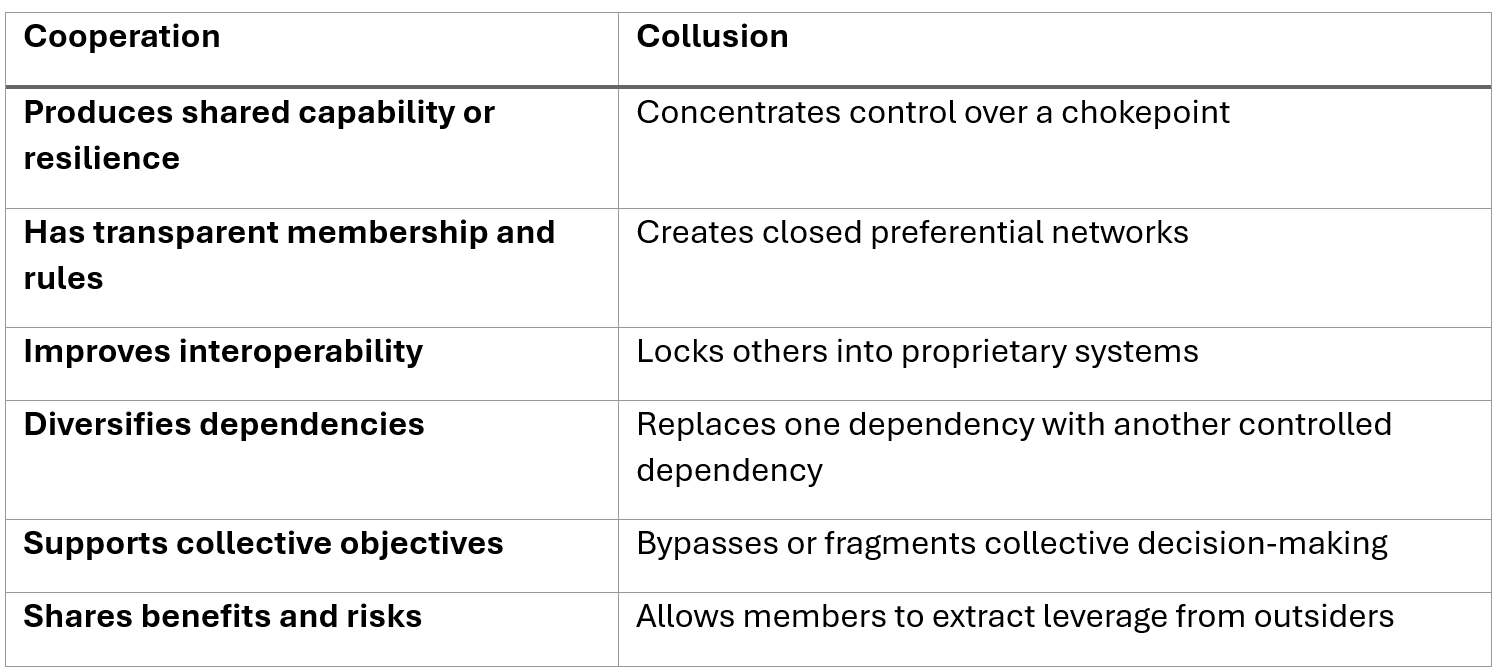
So the question is not are middle powers cooperating? It is what are they collectively gaining control over, who is excluded, and how does that alter the wider balance of power?
The deeper strategic pattern
Middle powers are not becoming more influential simply by accumulating national capability. They are gaining leverage by combining complementary assets around specific dependencies, markets, infrastructure systems and strategic problems.
The emerging unit of strategic power may therefore be neither the individual state nor the formal alliance. It may be the capability coalition, a network of governments, companies, resources, capital and infrastructure assembled around a particular dependency.
These coalitions can move faster than large multilateral institutions and connect countries whose interests align in one area but not across their entire foreign policies. They can also mobilize finance, industrial capacity and corporate infrastructure more directly than conventional diplomacy.
But they create new risks. They may fragment standards, form preferential clubs, move strategic authority toward private companies and create new dependencies inside arrangements intended to reduce them.
The future middle-power landscape is therefore unlikely to divide neatly into aligned and non-aligned states. It will consist of overlapping coalitions in which countries cooperate in one domain, compete in another and remain dependent on each other in a third.
The shift
The impact is a world order built less around fixed blocs and more around overlapping capability coalitions. Countries may cooperate with one group on security, another on technology and another on energy or manufacturing.
Canada and Germany illustrate how this works. Canada contributes resources, energy, Arctic access and AI capability. Germany contributes capital, industrial scale, advanced manufacturing and access to European markets. Together, they can gain greater control over shared dependencies than either could achieve alone.
Power increasingly belongs to the states and companies that control indispensable parts of these systems, including finance, standards, infrastructure, software, processing and market access. The result is a more distributed order, but not necessarily a more equal one. Dependence is not removed. It is reorganized across networks whose members can determine who participates, who remains outside and who retains access when conditions change.
The next question is whether middle powers can convert shared dependencies into collective freedom of action without creating new forms of exclusion, lock-in and concentrated control.