

Maven is already embedded in military workflows. Helsing is entering with an agent-native architecture and a wider portfolio of autonomous military systems.
Let’s look at what each architecture begins to make possible, which dependencies accumulate around it, and how those choices change warfare over the next several years.
Maven Smart System
Operationally established
Maven’s origins go back to 2017. It is used across the US defence establishment, and NATO’s version reached full technical operational capability on June 22, 2026, including accreditation for classified networks.
The Pentagon has also designated Maven a program of record, embedding it more firmly in future command-and-control modernization.
Clarity
Newly launched
Announced November 11, Clarity has hundreds of specialized agents coordinated through a shared evidence base and military ontology. Helsing says it can prepare information for different weapons and operate on customer-owned infrastructure.
Helsing has not publicly identified an operational Clarity customer or entry-into-service date. Reported testing in Ukraine is not equivalent to demonstrated operational adoption.
Maven has accumulated adoption, integrations, user practices and operational experience.
Clarity has an emerging technical proposition, defence-industrial relationships and a potentially different development trajectory.
Next let’s analyze what each is positioned to become, not compare launch-day feature lists.
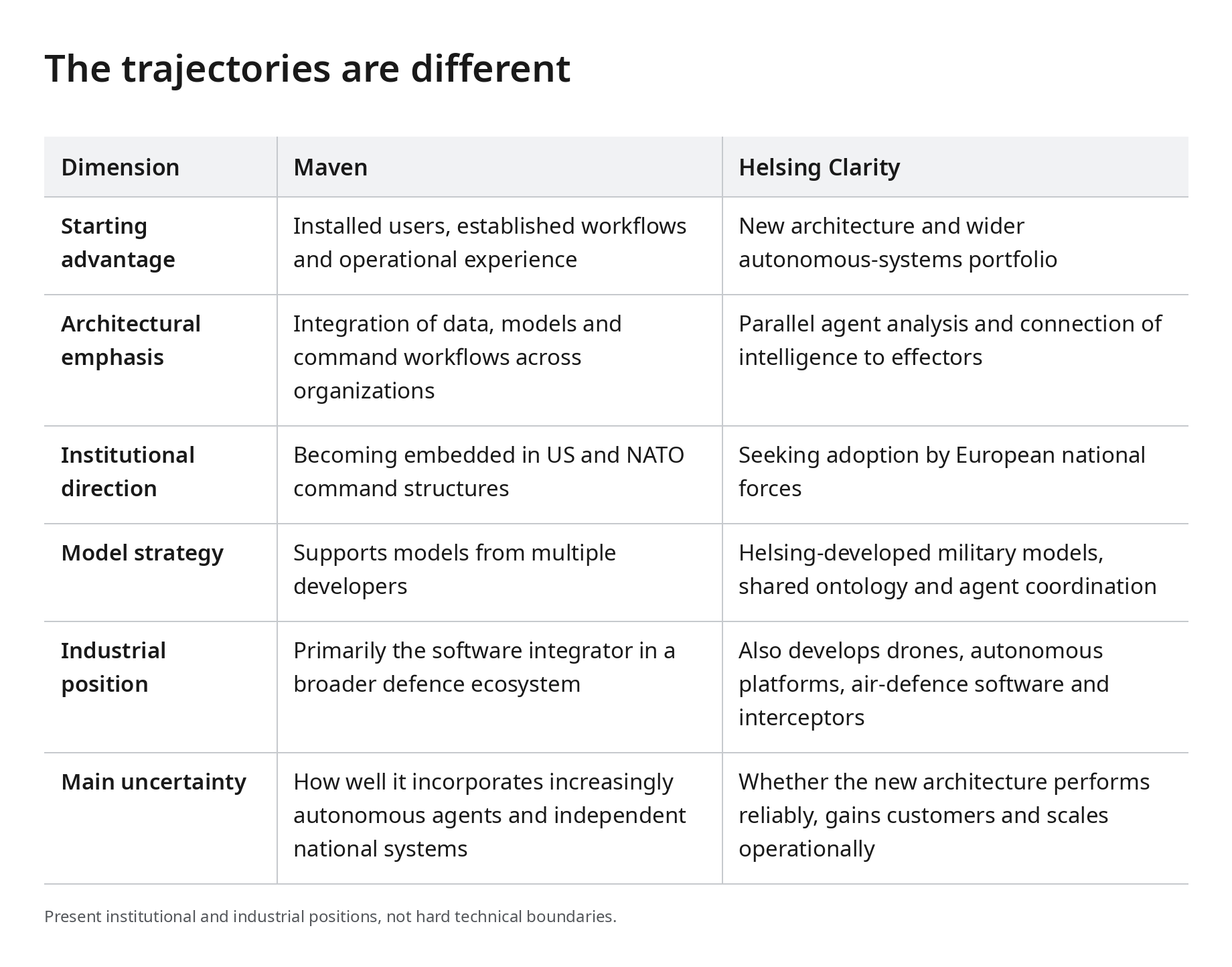
Sources: CSIS’s June 2026 Maven analysis, NATO’s August capability announcement, and Helsing’s November product documentation.
Maven is not just a legacy intelligence dashboard, and Clarity is not necessarily limited to tactical operations. Both claim broad integration capabilities. The distinctions above are their present institutional and industrial positions, not hard technical boundaries.
Maven’s trajectory: becoming part of the military institution
The significant development is that Maven is moving beyond being a tool that analysts use.
It is becoming embedded in how military organizations gather information, organize planning, coordinate functions and carry out command processes.
That creates an accumulating advantage:
More organizational adoption leads to more integrated workflows.
More integration raises the cost of replacing the system.
Training, procedures and organizational expectations increasingly develop around its capabilities.
Future modernization must account for systems already operating through Maven.
CSIS reports that Maven incorporates targeting, battlespace management, planning and growing command-and-control functions. NATO has already authorized its version for classified operations and exercises.
Maven could become an important part of NATO’s organizational infrastructure, even if individual nations choose different AI products.
But this position can be challenged. Germany is evaluating approximately 30 alternatives, with a prototype planned for the second quarter of 2027 and broader introduction targeted for 2028.
Helsing’s trajectory: linking software and autonomous hardware
Look at Helsing’s announcements across just 17 days.
October 26 — Contra
Helsing announces an autonomous air-defence architecture together with its AD-1 and AD-2 interceptor designs. The systems are intended to coordinate sensors, air-defence decisions and different effectors.
November 4 — MissionOSBw
Germany receives ownership of source code for a separate Helsing-led military software architecture intended to integrate systems from multiple manufacturers.
November 11 — Clarity
Helsing introduces an agent-based intelligence platform that prepares information for operational decisions and potentially different weapons.
These are distinct products, not a verified single end-to-end system.
But the industrial direction is visible.
Helsing is positioning itself across several parts of the military capability chain: information processing, software integration, autonomy and physical effectors.
That creates a possibility Palantir’s traditional business model does not approach in quite the same way.
Helsing could eventually influence both how a military interprets its environment and how the physical systems acting within that environment are developed.
That is worth examining as an industrial and organizational trajectory.
The second-order effects
A. Intelligence software may begin shaping defence procurement
This is the first important connection.
Consider how equipment is normally selected. Armed forces establish requirements, evaluate military capabilities and procure equipment expected to meet them.
Now introduce increasingly sophisticated software that must integrate sensors, interpret information and prepare data for different autonomous systems.
Over time, equipment that integrates easily with established software may become more attractive to procure.
That creates a potential feedback loop:
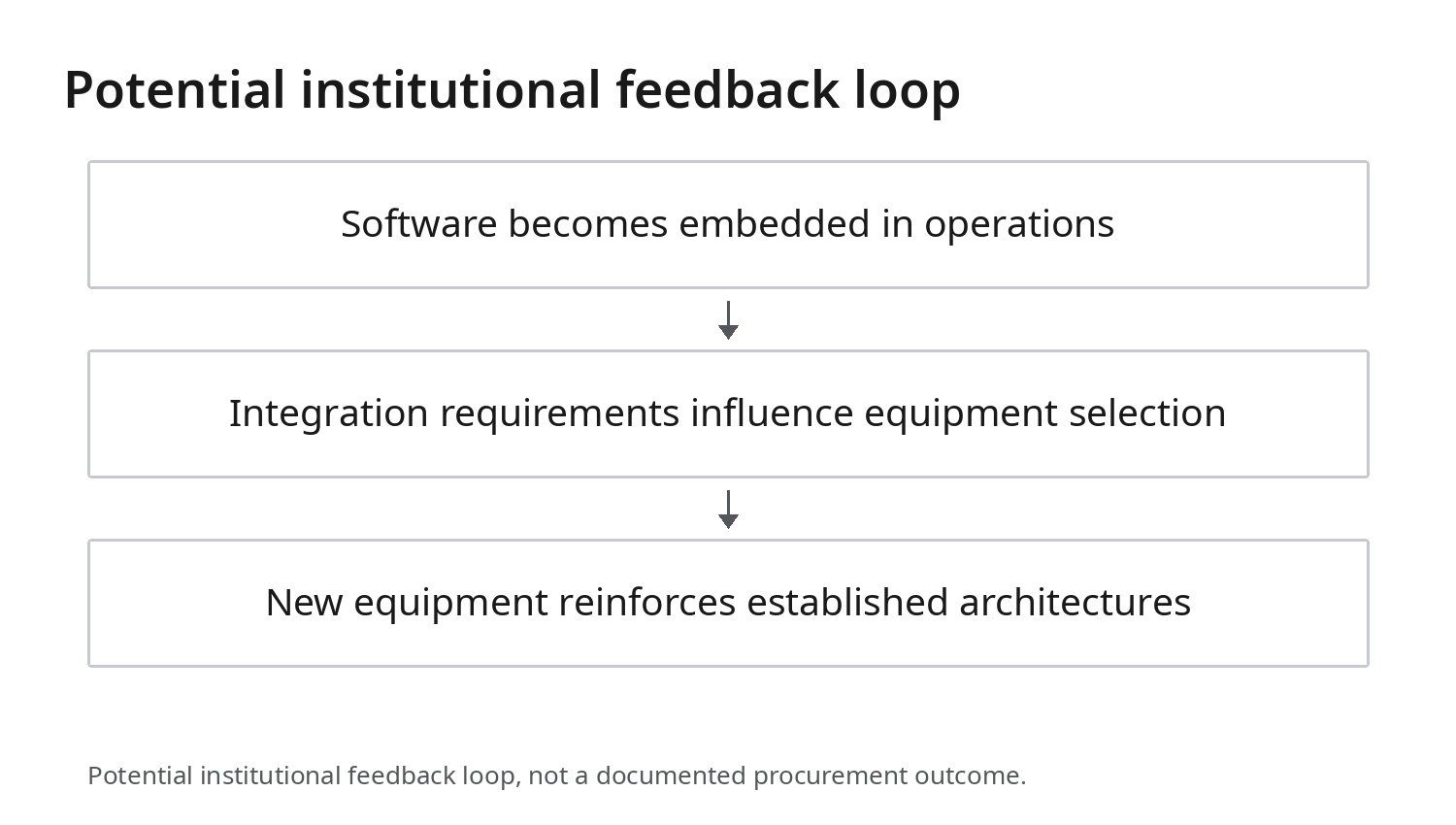
This could happen around either platform, though their industrial positions differ.
Maven’s influence would arise largely through established data structures and operational workflows.
Helsing’s could also arise through its relationships with autonomous hardware development and integration.
Software architecture could progressively shape which physical military capabilities are purchased and developed.
Helsing says Clarity can connect to weapons from any manufacturer, and Maven supports third-party models. Those design choices could help counter this effect. Whether they do so in practice depends on interoperability, procurement conditions and sustained openness.
NATO could develop two different speeds of institutional adaptation
Here’s another connection.
Maven is becoming established within alliance-level command structures.
Clarity enters at a time when European national militaries are trying to accelerate their own AI capabilities.
Imagine national forces adopting new agent-based systems and updating how they operate relatively frequently, while NATO’s common command arrangements evolve through multinational governance, accreditation and interoperability processes.
The difference is not necessarily processing speed.
It’s the rate at which institutions can change their operating practices.
National forces might discover useful new ways of coordinating sensors, analysts and autonomous systems. But integrating those changes into alliance structures may take longer.
Two effects could emerge:
National innovation accelerates because forces can evolve their own architectures.
Alliance coordination becomes more complex because those architectures and operating practices change on different schedules.
The reverse is also possible: a shared NATO platform could spread a useful innovation much faster across multiple countries than separate national systems could.
The determining factor may be about how quickly new capabilities and lessons can move between organizations.
Competition may shift toward controlling operational learning
Maven has an established base of users, systems integration and operational experience.
Helsing brings a different combination: military AI models, autonomous hardware, software development and experience supplying equipment to Ukraine.
Neither necessarily has an exclusive claim to operational learning. But they may accumulate different kinds of knowledge.
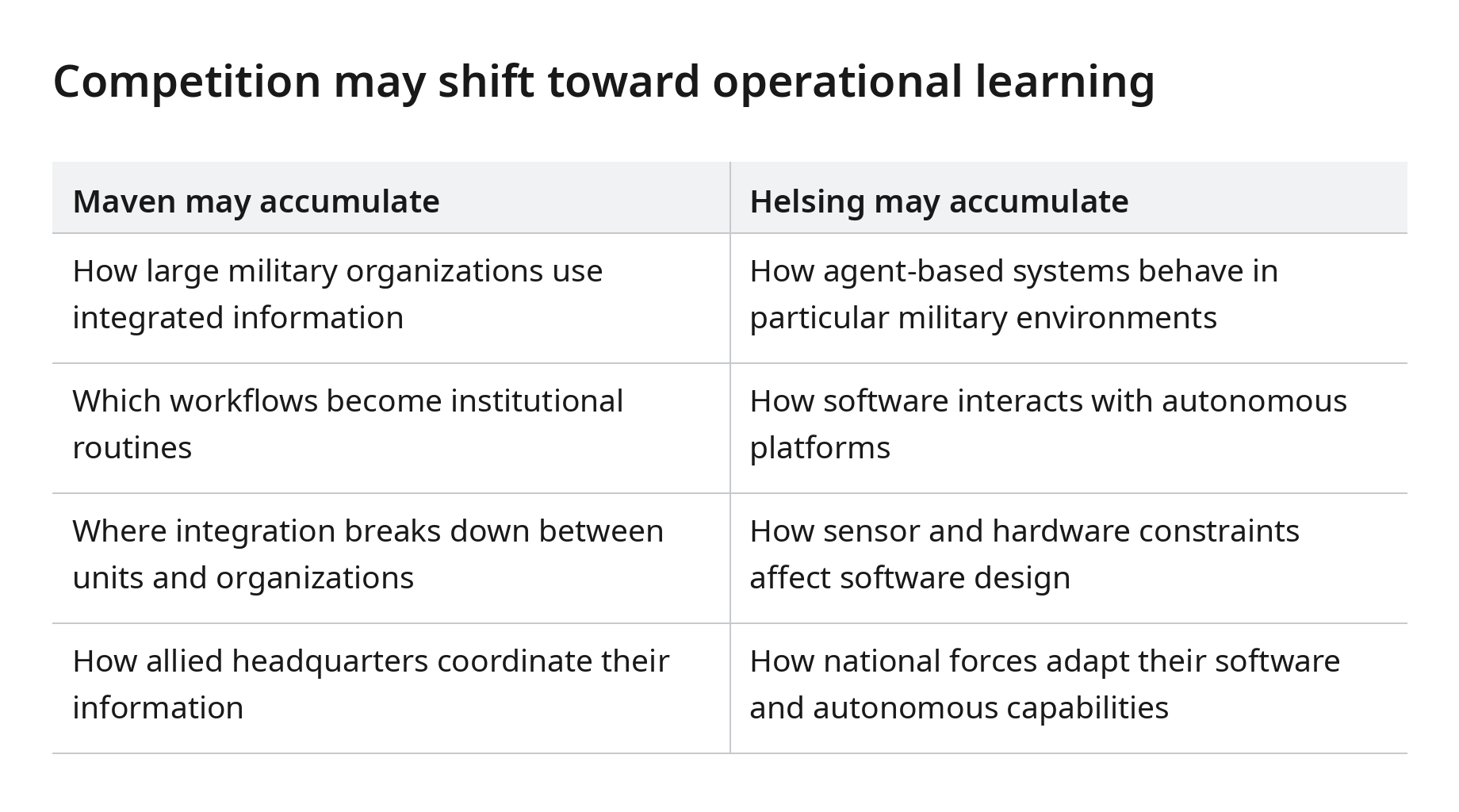
Some of this may occur through engineering changes and organizational learning rather than automated model retraining. Access to customers’ operational data is subject to contracts and controls.
The second-order possibility is that the value of a defence AI company increasingly depends on the operational learning relationships it establishes not simply the software it sells.
That could have substantial consequences for national sovereignty.
A country can own its data and its infrastructure while remaining dependent on external expertise to improve the capabilities operating on top of them.
Germany’s decision to acquire ownership of MissionOSBw’s source code is a meaningful response to part of that problem. But ownership alone doesn’t guarantee the ability to maintain and independently evolve a complex AI system.
The next competition could be between populations of agents, not platforms
Clarity explicitly uses hundreds of specialized agents coordinated through a shared ontology.
Maven already combines data, models and workflows from different sources. NATO says its deployment can support models from different AI developers.
Now consider the next stage: independent AI-enabled military organizations increasingly exchanging machine-generated assessments and requests.
The important question is no longer whether one system produces the same picture as another.
It’s whether the interactions between systems begin affecting the decisions, information priorities and institutional practices of the larger military organization.
For example, one national system’s output may influence which information another organization requests, what gets included in the coalition’s planning process and which activities receive further analytical attention.
Over repeated cycles, those interactions could create patterns that neither organization individually designed.
This would represent a movement from interoperability between software products toward collective behaviour between AI-enabled military institutions.
We have no evidence that such behaviour is already emerging between Maven and Clarity. But it is a plausible direction as agentic capabilities become more autonomous and interconnected.
Four possible trajectories for 2027–2030
These are alternative pathways, not probability-ranked forecasts.
A. A federated NATO architecture
Maven remains important within NATO headquarters. European national systems, potentially including Clarity, develop alongside it.
The crucial capabilities become shared interfaces, evidence provenance, cross-system coordination and the ability to preserve national control.
Outcome: NATO becomes an ecosystem of independently governed AI systems rather than a single-platform architecture.
B. Maven becomes the integrating layer
National systems continue developing, but Maven’s installed position allows it to become the environment through which increasing numbers of operational capabilities are coordinated.
Outcome: National technological diversity persists, while influence concentrates around a shared command-and-data architecture.
C. Competing operational ecosystems
Countries build deeper institutional relationships around different vendors. Their software, procedures, training and equipment choices evolve together.
Outcome: NATO must coordinate increasingly different national operating systems, with interoperability becoming an ongoing institutional challenge rather than a one-time integration task.
D. Governments reclaim the architectural centre
Germany’s MissionOSBw model spreads. Governments retain ownership or control over critical interfaces and can replace individual software suppliers.
Outcome: Competition shifts toward modular capabilities and models, while states retain greater control over how their military systems evolve.
The trajectories could also coexist at different military levels.
What would tell us which trajectory is emerging?
I would watch a small set of concrete developments rather than company announcements.
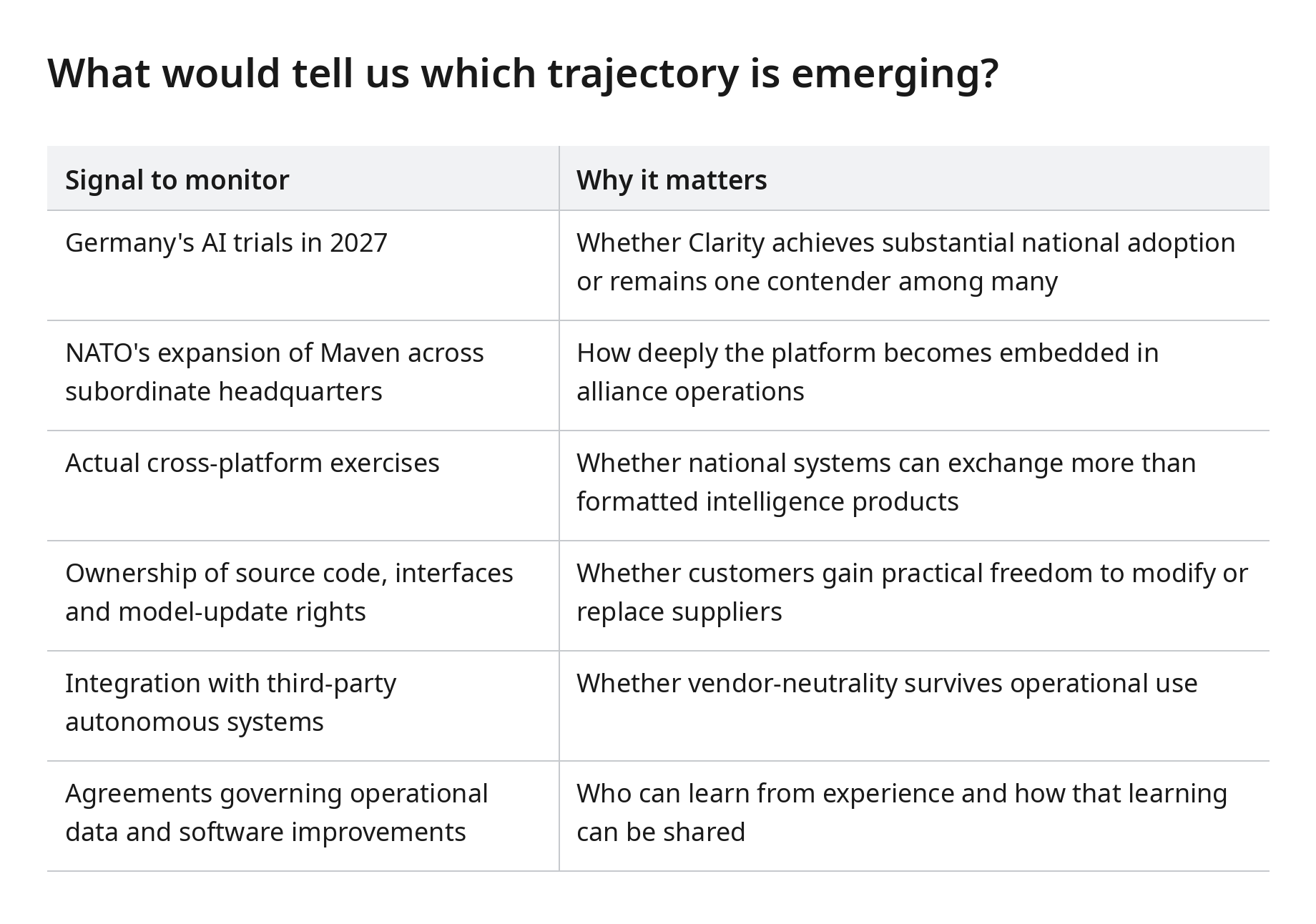
These are observable indicators we can return to as the market and military architectures develop.
What happens when intelligence software, organizational decision-making and autonomous military systems begin evolving together?
Historically, militaries have acquired equipment, developed doctrine, trained personnel and adapted their organizations through distinct processes.
Agentic systems could increasingly connect those processes.
That doesn’t mean doctrine or institutional authority automatically transfers to vendors. It means software could become a stronger influence on how operational practices develop, which equipment is valued and what information organizations learn from.
The future consequence may be a form of institutional co-evolution: software shapes military practices, those practices influence new requirements, and the resulting architectures shape the next generation of capabilities.
Maven and Clarity offer different starting points for that development.
Maven’s advantage is its established position inside military organizations. Helsing’s opportunity is its ability to develop intelligence software alongside autonomous military capabilities.
Neither guarantees the outcome.
And I wouldn’t assume that one will displace the other.
Their coexistence could become a test of whether NATO can develop collective AI-enabled military capability without requiring every nation to depend on the same architecture.
That is a much bigger question than who builds the better targeting software.