

What is emerging is not a stable third bloc between the United States and China.
It is a networked middle-power system made up of overlapping, capability-specific coalitions. Countries cooperate where their assets are complementary, compete where their industries overlap, and remain dependent on one another in areas they cannot control alone.
Middle-power influence is shifting from diplomatic status to functional control over strategic systems.
A country matters increasingly because it controls, supplies, finances, connects, protects or regulates something others cannot easily replace.
That could be:
minerals and energy
AI models, compute or data
industrial production
capital and project financing
ports, maritime routes and Arctic access
aerospace and space capabilities
standards, certification and market access
logistics and infrastructure
diplomatic access across competing blocs
The result is best understood as portfolio alignment. Countries maintain several overlapping partnerships rather than making one permanent geopolitical choice.
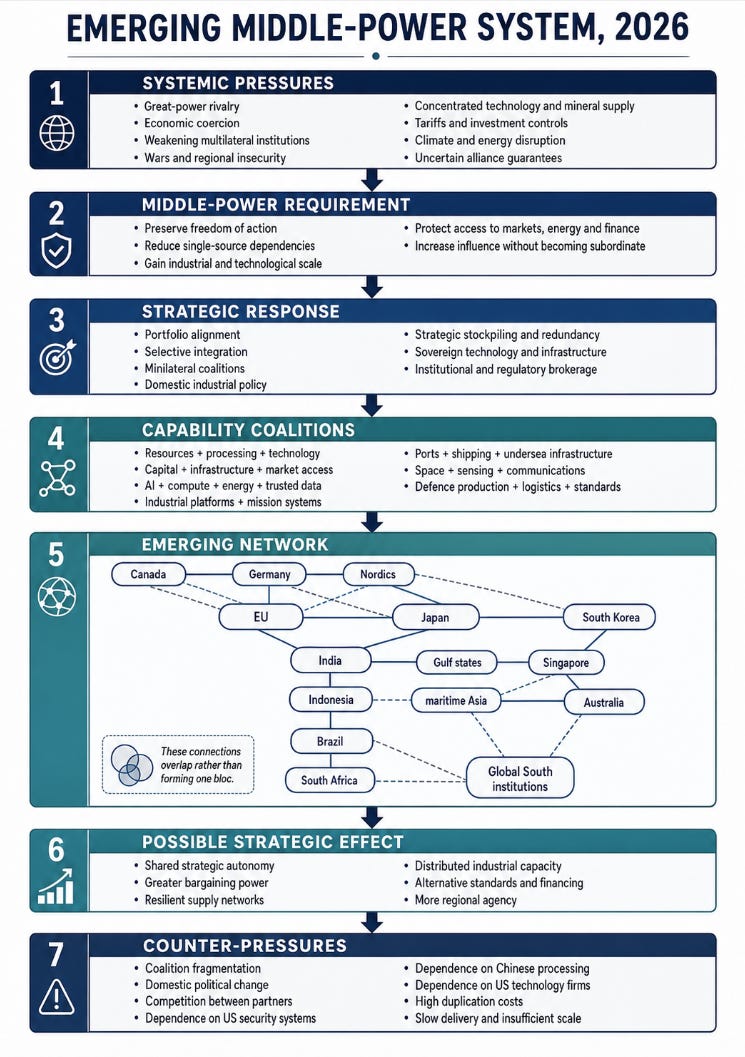
What is driving the change
Rules are no longer considered sufficient protection
Middle powers traditionally relied on institutions, international law and predictable access to global markets. Those mechanisms remain important, but countries increasingly doubt that they will prevent tariffs, export controls, financial pressure, technological denial or supply interruption.
Canada’s January 2026 middle-power doctrine captured this directly. Prime Minister Mark Carney argued that integration itself can become a source of vulnerability and that countries are therefore seeking greater autonomy in energy, food, critical minerals, finance and supply chains. He also argued that collective resilience is less costly than every country attempting complete self-sufficiency.
This produces an important distinction:
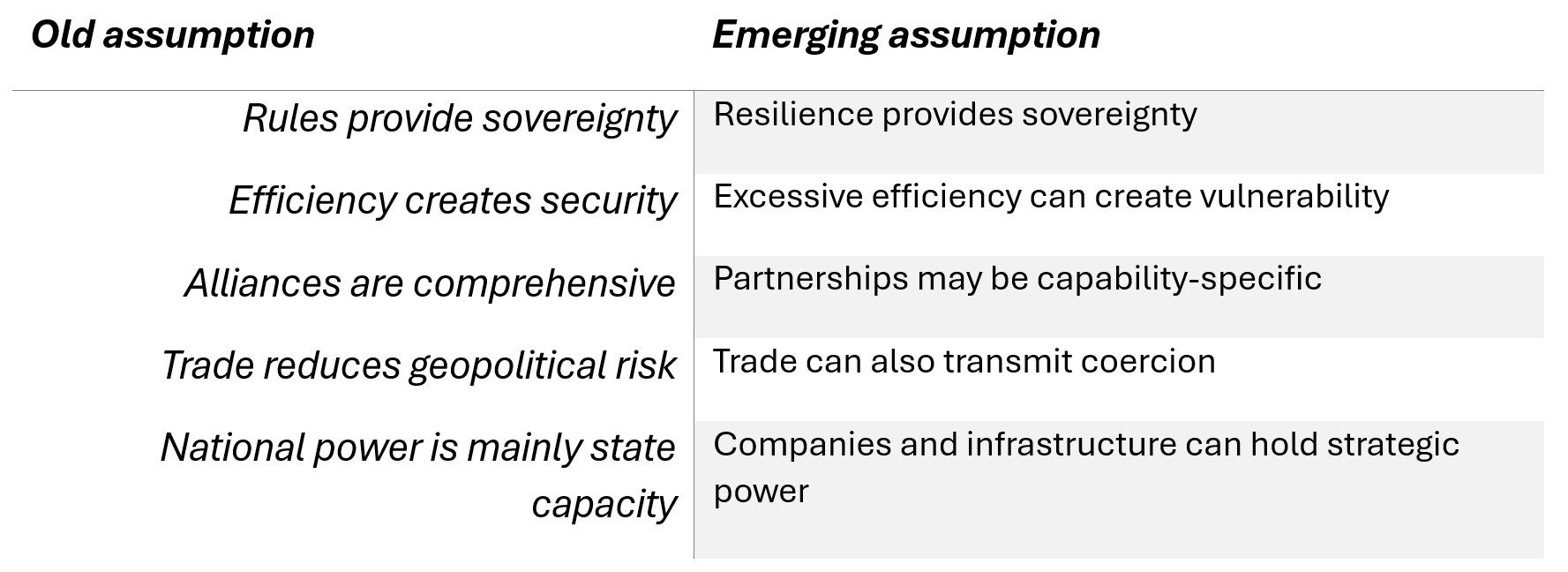
The system is not simply deglobalizing. Global trade reached approximately $35 trillion in 2025, while new connector economies expanded trade with multiple competing centres. The deeper change is rerouting and restructuring, not the disappearance of international integration.
The new unit of power is the capability stack
Middle powers rarely control an entire strategic value chain. They gain influence by combining complementary pieces.
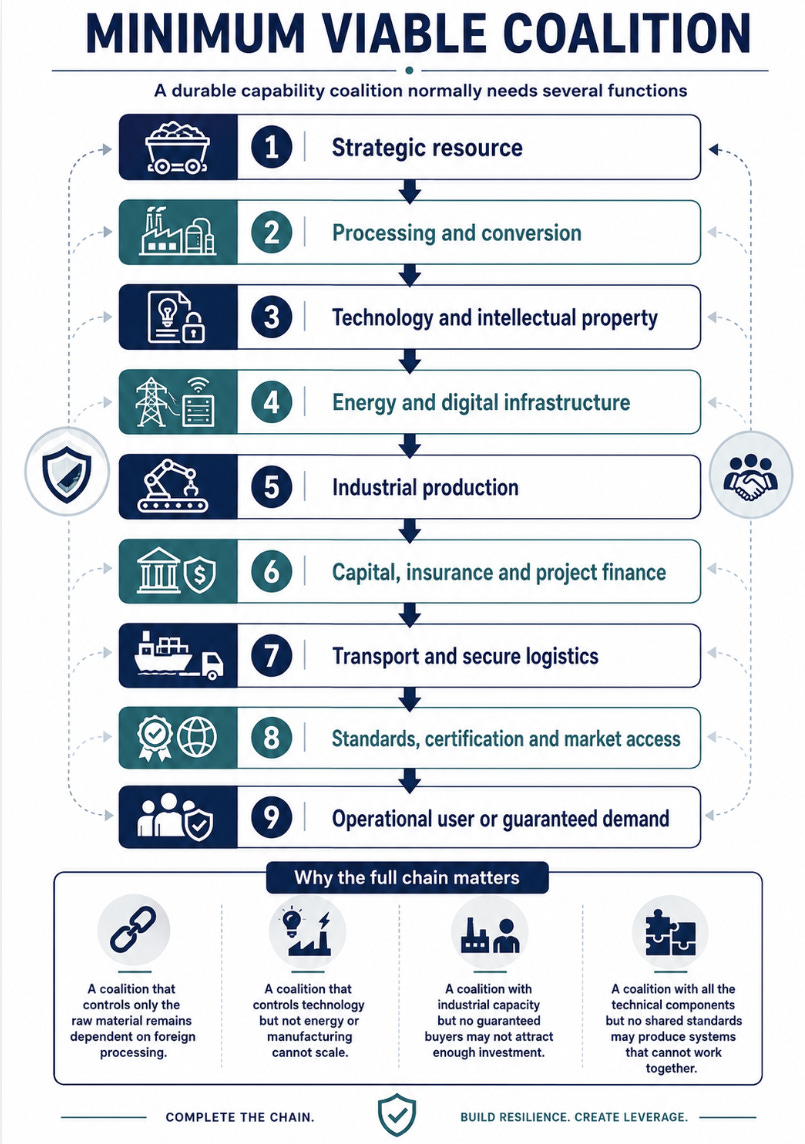
What minimum viable coalition can control enough of the full chain to withstand outside pressure?
The principal middle-power archetypes
Countries occupy different positions in the emerging system. Many belong to more than one category.
Industrial platform powers
Germany, Japan, South Korea, Sweden, Poland, the Netherlands and increasingly Türkiye
Their influence comes from manufacturing, engineering, specialized firms, production knowledge, industrial standards and integration into advanced supply chains.
Their central problem is that industrial capability may depend on imported energy, critical minerals, semiconductors, software or external markets.
Their preferred coalitions connect industrial capacity with resource producers, technology ecosystems and reliable export markets.
The EU–Japan Competitiveness Alliance illustrates this model. It links critical minerals, semiconductors, energy, defence, space, research and digital cooperation rather than treating trade, security and technology as separate policy areas.
Resource and energy powers
Canada, Australia, Norway, Saudi Arabia, the United Arab Emirates, Brazil, Indonesia and Chile
These states possess minerals, energy, land, renewable potential or processing leverage. Their strategic objective is increasingly to move beyond extraction into refining, manufacturing, technology and ownership.
Indonesia demonstrates how resource control can be converted into industrial leverage. Its position in nickel has increased its bargaining power with both Chinese and Western industrial systems. The IEA reports that Indonesia accounted for most recent growth in nickel refining, while mineral processing more broadly remains highly concentrated.
The danger for these countries is remaining upstream suppliers in someone else’s industrial system.
Technology and knowledge powers
Canada, South Korea, Singapore, Israel, Sweden, Finland, the Netherlands and parts of India
Their leverage comes from AI research, advanced engineering, digital infrastructure, semiconductor equipment, telecommunications, cybersecurity, robotics or specialized talent.
But technological power is highly layered. Having AI researchers does not automatically provide control of advanced chips, fabrication, cloud infrastructure, data centres, electricity, foundational models, capital, deployment platforms
The 2026 AI Index identifies a sharply concentrated system. The United States hosts far more data centres than any other country, while one Taiwanese foundry fabricates almost all leading AI chips. At the same time, South Korea leads in AI patents per capita and China and the United States hold different advantages across research, models, patents and industrial robotics.
This creates a growing group of technological swing states that possess valuable pieces of the AI system without controlling the entire stack.
Capital and infrastructure powers
The UAE, Saudi Arabia, Singapore, Qatar and Norway
These actors can translate sovereign capital, infrastructure investment, energy and logistics into strategic influence.
They can finance projects that industrial and resource powers cannot fund independently. They can also connect Western technology, Asian manufacturing and Global South markets.
Their influence comes partly from their ability to operate across political systems rather than entering one exclusive bloc.
Geographic and logistical bridge powers
Türkiye, India, Indonesia, Saudi Arabia, the UAE, South Africa, Singapore and Canada
These countries sit between regions, maritime routes, energy systems or political groupings.
Their territory, ports, air corridors, Arctic access, undersea infrastructure or diplomatic reach make them difficult to bypass.
Their power rises when:
shipping routes become less secure
sanctions redirect trade
supply chains require alternative corridors
allies need access to distant theatres
regional crises interrupt normal routes
However, connector status is not automatically safe. IMF research finds that countries benefiting from redirected trade may become more exposed to later fragmentation, retaliation or demand shifts.
Institutional brokers
Canada, Japan, India, Brazil, Indonesia, South Africa and Singapore
These states participate in multiple institutions and can translate ideas between different groups.
India, for example, can participate in the Quad, BRICS, the G20 and partnerships with Europe and the Gulf without treating any one relationship as exclusive. The January 2026 EU–India partnership expanded cooperation across maritime security, technology, space, defence industry, cyber and connectivity.
BRICS is also expanding as a venue for bargaining over financing, local-currency transactions and Global South representation. Its membership and internal diversity suggest that it is better understood as a negotiation and option-building platform than as a cohesive strategic alliance.
What the emerging coalitions look like
Coalition type one
Trusted industrial complementarity
Countries combine resources, technology, capital and manufacturing because none can achieve strategic scale independently.
The February 2026 Canada–Germany Sovereign Technology Alliance is an early example. It connects secure compute, AI research, commercialization, skills and resilient digital infrastructure while explicitly seeking to reduce strategic technology dependencies.
The underlying complementarity is broader:
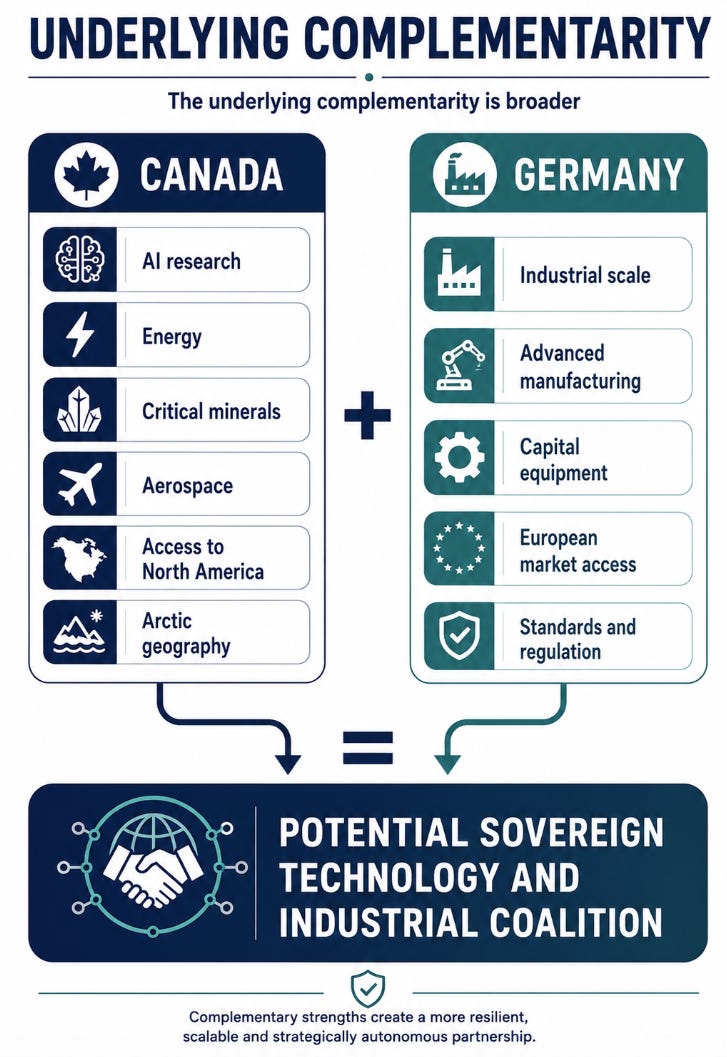
The coalition matters only if it advances from declarations to shared infrastructure, financed projects, commercial demand and deployable capability.
Coalition type two
Cross-regional security-industrial partnerships
Europe and the Indo-Pacific increasingly view their security environments as connected.
EU–Japan and EU–India arrangements now combine economic security with maritime, cyber, space, industrial and technological cooperation. These are not traditional military alliances. They are cross-regional resilience partnerships.
They reflect a wider recognition that European security depends on Indo-Pacific production and trade and Indo-Pacific security depends on European markets, technology and diplomatic support.
Coalition type three
Resource-to-industry coalitions
These bring together resource producers and industrial consumers.
The objective is not simply reliable supply. It is shared control of extraction, processing, recycling, component production, standards, long-term purchasing, project finance.
This is urgent. The top three refining countries controlled approximately 86 percent of refining for major energy minerals in 2024, up from roughly 82 percent in 2020. Around 90 percent of supply growth came from the leading supplier, principally China across most minerals and Indonesia for nickel.
There is not one fixed set of three countries behind the 86% figure. The IEA calculated the top three refiners separately for each mineral, copper, lithium, nickel, cobalt, graphite and rare earth elements and then averaged their combined shares.
The clearest country-level picture is:
China is the leading refiner for copper, lithium, cobalt, graphite and rare earth elements.
Indonesia is the leading refiner for nickel.
No single third country. The other leading positions vary by mineral, involving countries such as Chile, Japan, Argentina and others.
Canada has consequently established or expanded critical-mineral mechanisms with Germany, Australia, Saudi Arabia, Japan, South Korea, the EU, Chile and others.
Coalition type four
Sovereign AI networks
The emerging AI coalition is not simply a group of countries building national language models.
It involves shared access to trusted models, compute, electricity, data, cloud infrastructure, advanced chips, talent, safety and evaluation systems, procurement demand, interoperable governance.
Few middle powers can build this stack nationally. Their realistic route is federated technological sovereignty, where countries share infrastructure and standards while retaining authority over data, models and sensitive applications.
This could become one of the defining middle-power coalition spaces between 2026 and 2030.
Coalition type five
Capital-resource-technology triangles
Gulf states increasingly connect western technology, Asian industrial capacity, energy and land, sovereign investment, access to African and South Asian markets.
These are not merely bilateral relationships. They are often triangular or quadrilateral arrangements.
Technology state -> Gulf capital and energy -> Resource or market state -> Industrial production partner
This gives the Gulf states influence far beyond their population size. Their role is shifting from energy supplier to capital allocator, infrastructure owner and technology platform host.
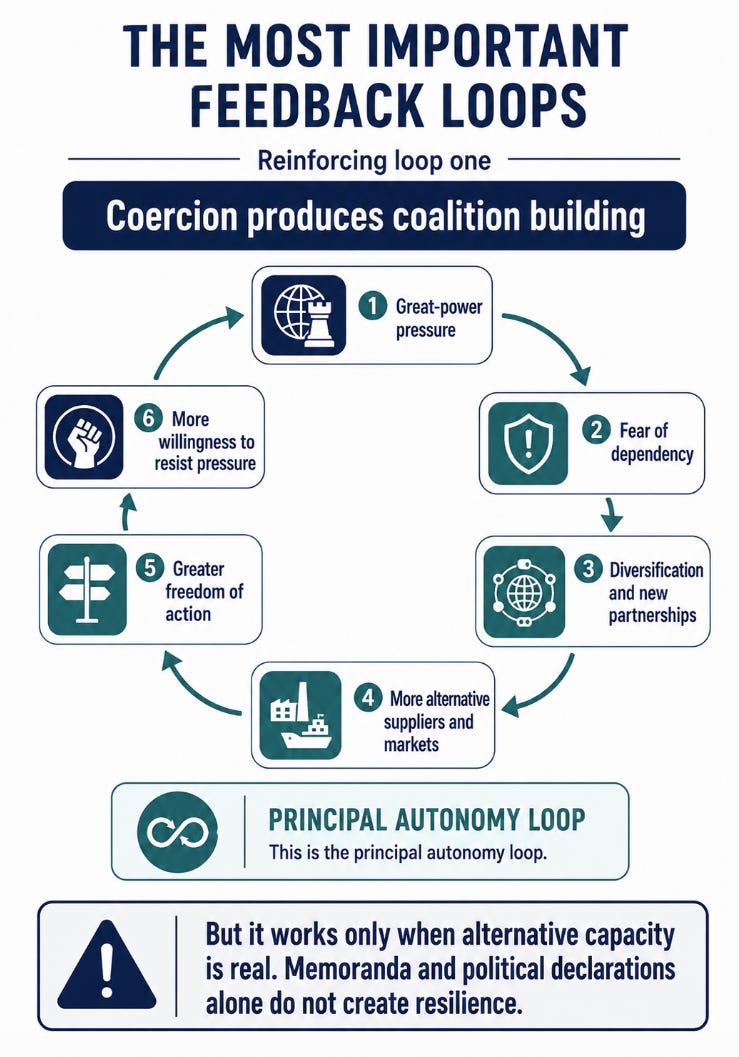
Reinforcing loop one.
Reinforcing loop two
Capability attracts capability
Initial strategic asset -> Foreign investment -> Domestic infrastructure and skills -> Higher-value production -> Greater bargaining power -> More investment
Indonesia’s nickel strategy demonstrates this potential, although it also illustrates the risk that domestic industrial development may remain heavily dependent on foreign capital and technology.
Reinforcing loop three
Standards create markets
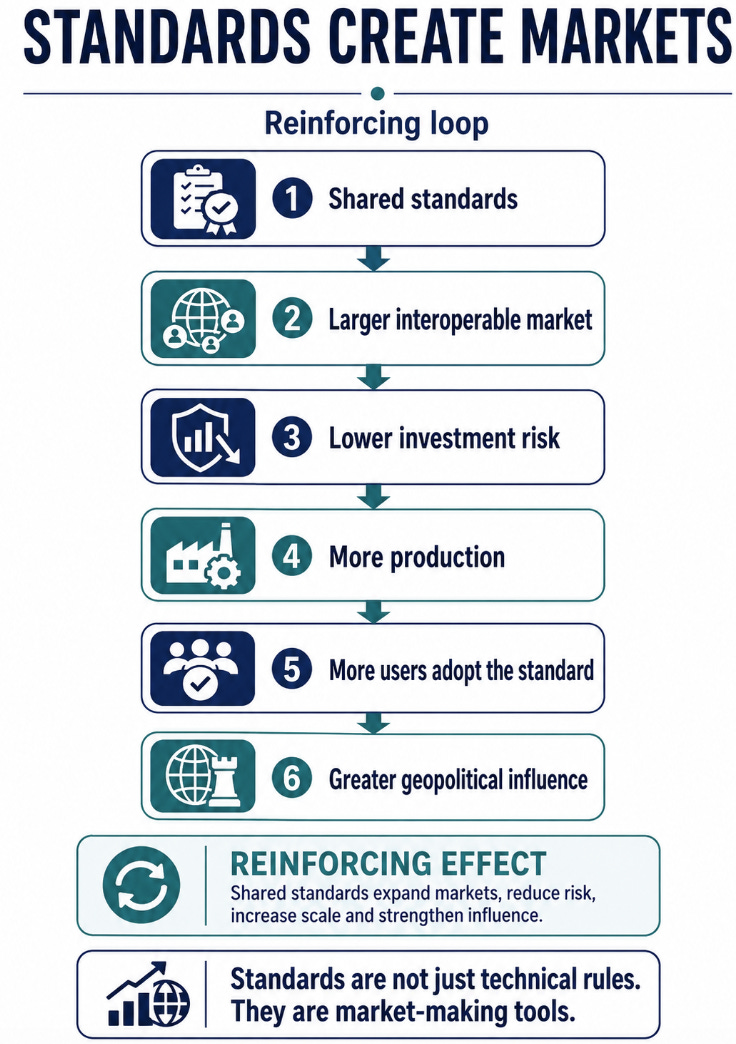
This is why certification, data rules, AI governance, environmental standards and interoperability can have effects comparable to conventional industrial policy.
Balancing loop one
Autonomy is expensive
More redundancy and domestic capacity -> Higher costs -> Fiscal and political pressure -> Reduced investment -> Continued dependency
Not every supply chain can or should be reproduced domestically. The strategic challenge is identifying which dependencies are genuinely intolerable and which can be managed through diversification.
Balancing loop two
Coalitions fragment under pressure
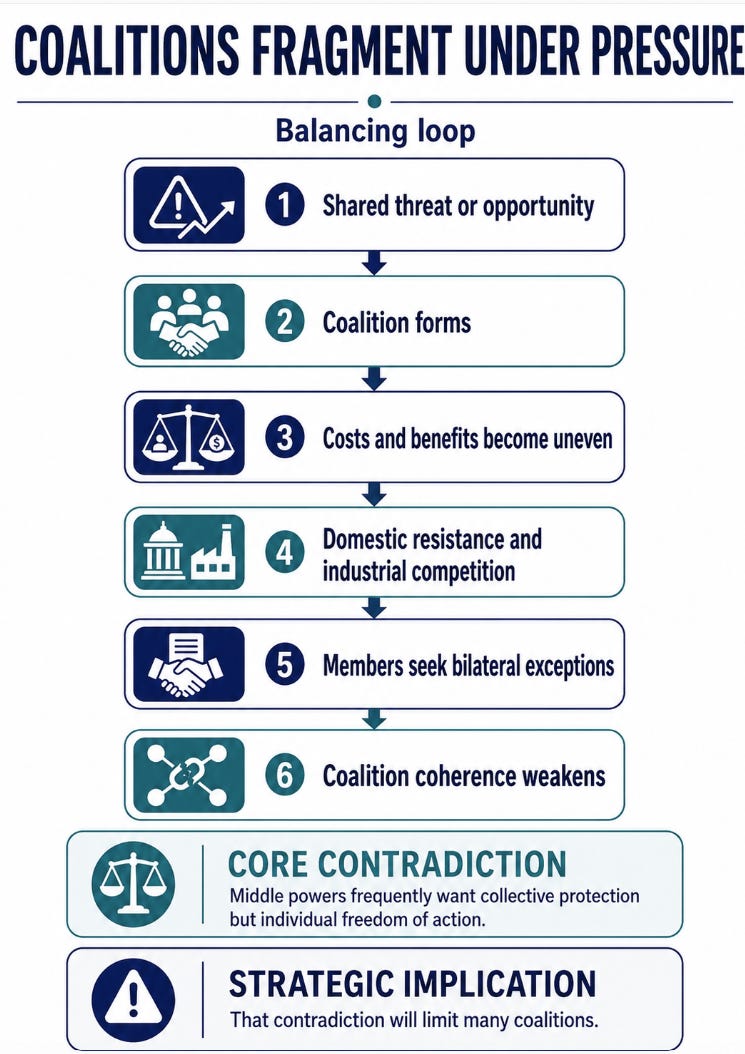
Middle powers frequently want collective protection but individual freedom of action. That contradiction will limit many coalitions.
Balancing loop three
The hidden great-power dependency
A coalition may appear autonomous while still depending on:
US security guarantees
US cloud and AI firms
Chinese mineral processing
Taiwanese semiconductor fabrication
European regulatory access
dollar-based finance
This means that some middle-power coalitions will diversify dependencies rather than eliminate them.
The emerging regional laboratories
The Arctic
The Arctic is becoming a test of whether middle powers can integrate sovereignty, infrastructure, Indigenous partnership, sensing, energy, logistics and industrial capability.
Canada, Norway, Finland, Sweden and Denmark possess different but complementary assets. The region could produce capability coalitions around:
communications and sensing
resilient infrastructure
energy and minerals
aerospace and maritime awareness
cold-weather mobility
civil-military logistics
trusted data and AI
The Arctic therefore connects security, climate, economic development and infrastructure in one system.
The Indo-Pacific
The Indo-Pacific is the most advanced laboratory for portfolio alignment.
Japan, India, Australia, South Korea, Indonesia and Singapore simultaneously maintain:
US security relationships
economic links with China
regional institutions
bilateral technology agreements
independent industrial strategies
This is not indecision. It is deliberate risk management.
The Gulf and wider Middle East
The Gulf demonstrates how energy and capital powers can acquire technological and geopolitical agency.
Saudi Arabia, the UAE and Qatar are increasingly able to choose among American, European, Chinese, Indian and other partners. Their decisions influence AI infrastructure, energy transitions, logistics, financing and regional diplomacy.
Europe
European middle powers are moving from being principally consumers of collective security toward becoming industrial and capability producers.
Military spending in Europe rose by 14 percent in 2025, while spending in Asia and Oceania increased by 8.1 percent. Germany, Poland, Japan, Australia, South Korea and other states are consequently gaining more weight within their respective alliance systems.
The strategic question is whether higher spending becomes fragmented national capacity or interoperable strategic mass.
The deepest emerging pattern
The middle-power landscape is becoming a multiplex network.
A country can be:
allied with another country militarily
dependent on it technologically
competing with it industrially
cooperating with it on critical minerals
divided from it on trade
partnered with it in a third region
This means the future system is unlikely to divide neatly into aligned and non-aligned countries. It will consist of overlapping coalitions in which countries cooperate in one domain, compete in another and remain dependent on each other in a third.
The central contest will therefore be less about recruiting countries permanently into one camp and more about determining:
Which coalition controls each critical capability.
Which standards its members adopt.
Where infrastructure and production are located.
Who provides the capital.
Who owns the data and intellectual property.
Who has guaranteed access during a crisis.
Who can exit the arrangement without unacceptable costs.
Four plausible pathways to 2030
Pathway one - Networked strategic autonomy
Middle powers build functioning coalitions across AI, minerals, energy, infrastructure and industrial production.
They remain allied with larger powers but become less vulnerable to sudden policy changes.
This is the most positive pathway.
Pathway two - Competitive capability clubs
Coalitions form, but access becomes conditional.
Trusted groups create separate technology, industrial and financial systems. Middle powers gain resilience inside their clubs but lose access outside them.
This would produce partial bloc formation without two completely separate global economies.
Pathway three - Connector-state ascendancy
India, the Gulf states, Indonesia, Türkiye, Brazil and others gain influence by linking competing economic systems.
Their bargaining power rises, but so does pressure from larger powers to choose sides.
The decisive variable will be whether they develop domestic production or remain routes through which other powers trade.
Pathway four - Fragmented sovereignty
Middle powers announce numerous alliances but fail to finance or implement them.
Dependence remains concentrated, costs rise, projects are duplicated and domestic political changes repeatedly interrupt cooperation.
Under this pathway, the language of strategic autonomy expands faster than actual capability.
The strategic insight for Canada and NATO
The opportunity is not to create a formal alliance of middle powers.
It is to become an architect and indispensable node of capability coalitions.
Canada’s most useful assets are not isolated national strengths. They are the combinations it can offer:
AI + energy + secure compute
Critical minerals + trusted standards + market access
Arctic geography + sensing + infrastructure
Aerospace + European and Nordic mission technologies
Research + allied industrial production
North American access + European partnerships
NATO membership + Indo-Pacific relationships
For NATO, the challenge is to turn a growing web of bilateral and minilateral partnerships into real collective capability. That means connecting nationally owned forces, industrial capacity, data, infrastructure and technology so they can produce greater scale, resilience and operational effect together, without requiring every initiative to be absorbed into a single centrally controlled alliance system.
The advantage will come from federation of common standards, interoperable interfaces and shared objectives, combined with distributed ownership and national freedom to contribute at different levels.
Federated capability coalitions with common outcomes, interoperable interfaces and distributed national ownership.
Final assessment
The middle-power moment of 2026 is not primarily a diplomatic movement.
It is the early formation of a new operating system for international power.
Its basic unit is the capability coalition.
Its organizing behaviour is portfolio alignment.
Its strategic objective is decision sovereignty.
The principal source of influence is control of an indispensable function within a wider network.
And its central vulnerability is that most middle powers are still trying to construct autonomy using infrastructure, technology, finance and security systems controlled by the great powers.