

Defence marketplaces determine what gets bought and who gets paid. But could their rules also shape what the adversary does next?
I’m preparing for NATO EDGE in Türkiye next week, investigating whether these marketplaces could do more than accelerate procurement. Could their incentives also change the economics of adversary mass, scale and adaptation?
So we tested five different purchasing rules in an agent-based simulation.
The result was that the rule that forced the adversary to spend the most adapting also allowed the most of its weapons to survive.
The experiment started in Ukraine
Ukraine’s battlefield rewards system, connected to Brave1 Market, has turned battlefield results into purchasing power. Military units earn points for verified operational results, with different values assigned to different targets. A destroyed tank, for example, has been worth 40 points. Units spend those points on drones and other equipment from competing manufacturers.
The consequences are significant. Units that score more get more equipment, and the most successful units attract a disproportionate share of resources. Manufacturers compete for those orders, while Kyiv can change battlefield priorities simply by changing the points awarded for different targets.
But the system also creates opportunities for gaming. Soldiers have described units claiming each other’s hits and striking vehicles that were already disabled, just to collect more points.
The same incentives that reward performance can also change what soldiers target, which units get resources and what manufacturers produce.
The US is developing a different model. Its Drone Dominance Program uses competitions, larger orders and price targets to encourage manufacturers to produce affordable drones at scale.
NATO launched its counter-drone marketplace on November 5, with 16 preselected products from five companies. Allies can purchase them without another tender.
All three marketplaces change purchasing behaviour. But what do they do to the adversary?
So let’s test the rules
I challenged Fable 5.2 to build an agent-based simulation with up to 48 manufacturers, 30 military units and one adapting adversary.
The manufacturers developed and sold competing products. Military units purchased equipment based on the rewards available to them.
The adversary produced weapons at scale. The longer it manufactured the same design, the cheaper production became. When a defensive technology became sufficiently effective, the adversary could develop a countermeasure. But redesigning its weapons increased costs and disrupted production efficiencies.
We allowed each simulated market to develop for two years, then copied it into five identical versions.
Each version received a different purchasing rule: periodic competitions, rewards for kills, premiums for rare designs, payments for costs imposed on the adversary, or premiums for new designs.
We repeated this across 40 starting markets and observed what happened over the following six years. (calculated in weekly steps).
What happened?
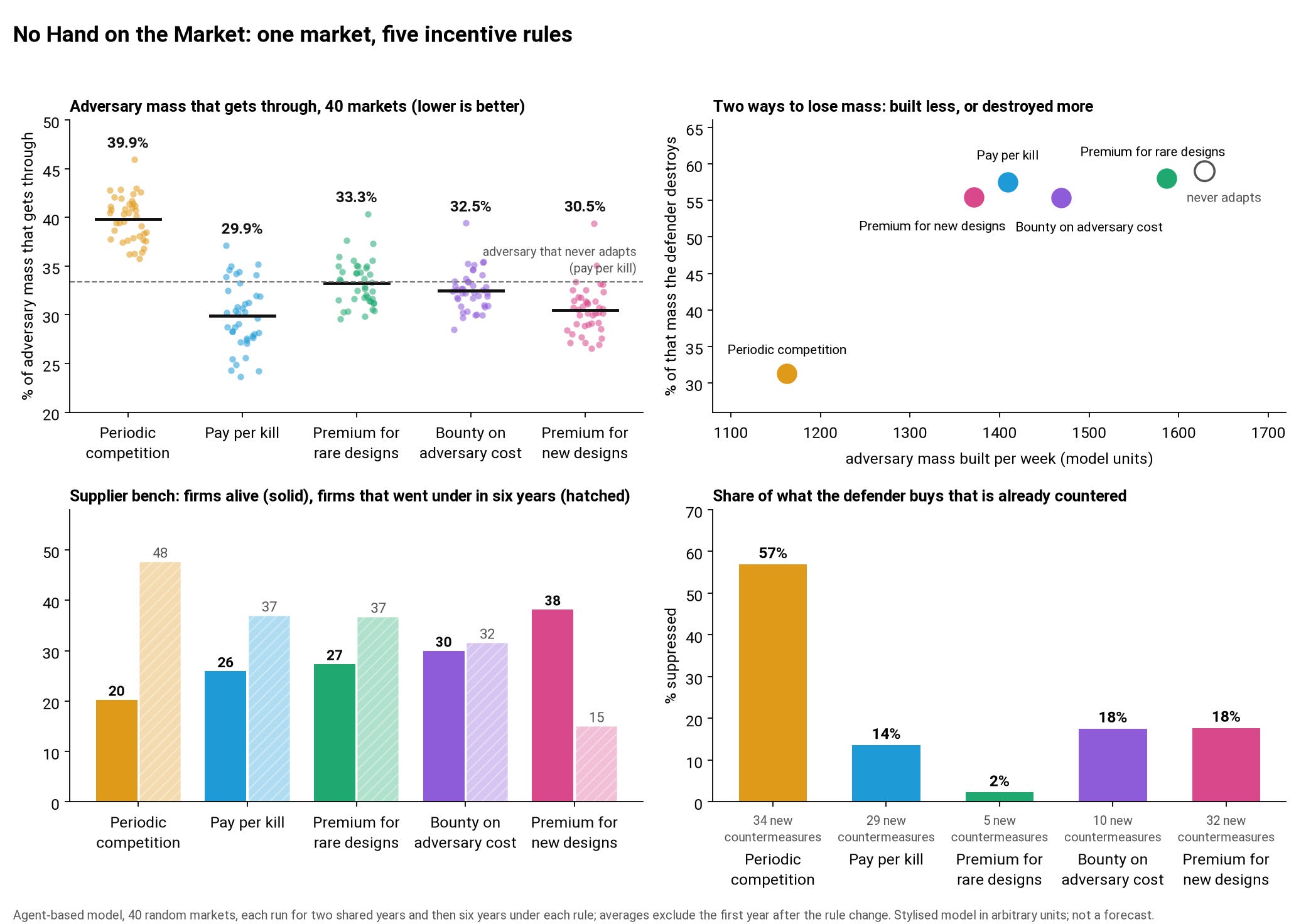
In the periodic-competition market, five winning products received most of the orders for six months.
Winning manufacturers gained predictable demand and invested in capacity, while more companies failed than under any other rule. The adversary developed countermeasures while military units continued purchasing the winning products.
On average, about two-thirds of spending went to designs the adversary had already countered.
The adversary spent heavily adapting, produced fewer weapons and still achieved the best outcome of any rule we tested.
In the pay-for-results market, purchasing power moved toward units achieving verified effects.
When a product stopped working, units shifted their purchases. Manufacturers responded to the changing demand. The adversary developed countermeasures, but by the time some became effective, buyers had moved to other designs.
Only about one-tenth of spending went to already-countered products.
The adversary produced more weapons each week, but a much smaller share of its potentially affordable mass survived: approximately 30%, compared with 40% under periodic competition.
Next we rewarded diversity.
We gave units extra purchasing power for buying designs that few others used.
The adversary encountered so many different designs that developing individual countermeasures became less worthwhile. It adapted only five times in six simulated years, compared with 29 under pay-for-results.
That sounds like success.
Except the adversary kept its production line stable, produced the largest volume of weapons and achieved a better outcome than against the simpler results-based market.
Then we tried rewarding units for imposing costs on the adversary.
That produced another unexpected behaviour. Under a heavy version of the reward, units kept buying designs the adversary had already countered because those designs continued generating payments.
We had created an incentive to keep purchasing equipment that was no longer effective.
Finally, rewarding new designs kept more manufacturers in business, but didn’t materially outperform the simple results-based rule.
Four futures emerged
These are possible trajectories suggested by the experiment, not forecasts.
The catalogue war. Procurement cycles are slower than adversary adaptation. We keep buying and stockpiling products that are already being countered.
The treadmill. Military units, manufacturers and adversaries continually respond to one another. Both sides keep adapting. Advantage depends on who can change faster and at lower cost.
The quiet front. We achieve technological diversity and face fewer countermeasures, but the adversary retains the manufacturing efficiencies that make mass cheap.
The points economy. Units become very good at earning rewards. The marketplace reports success while operational effectiveness diverges.
Which future is more likely?
I suspect we’ll see the catalogue war and treadmill operating together.
Ukraine has demonstrated how quickly operational feedback can influence purchasing, although it also exposes the risks of gaming. NATO and the US are building mechanisms to accelerate procurement and production, but without equivalent battlefield feedback, they face a different problem: how do you know when something you are still purchasing has stopped being effective?
And there is a larger implication.
The adversary that spent the most adapting was also the one that got the most weapons through our defences. Simply measuring how much we forced it to spend would have led us to the wrong conclusion.
We need to understand the relationship between our purchasing decisions, the adversary’s response, and the military effects that follow.
The simulation is stylized and unvalidated. Its results depend on assumptions about adaptation costs, how quickly buyers respond and how intelligently the adversary anticipates their behaviour. It also did not test wartime production surges, where greater industrial capacity might matter. It demonstrates possible mechanisms, not real-world outcomes.