

A blunt message circulating at the highest levels of U.S. leadership is worth looking at carefully, and not at the surface “Trump said X” level. There are system signals embedded here that matter for defence, industry, and the kind of work many of us are already doing.
At its core, this was a statement about purpose. It redefined what defence companies are expected to deliver and how their success is meant to be measured.
What follows is a clean systems read, not a political take.
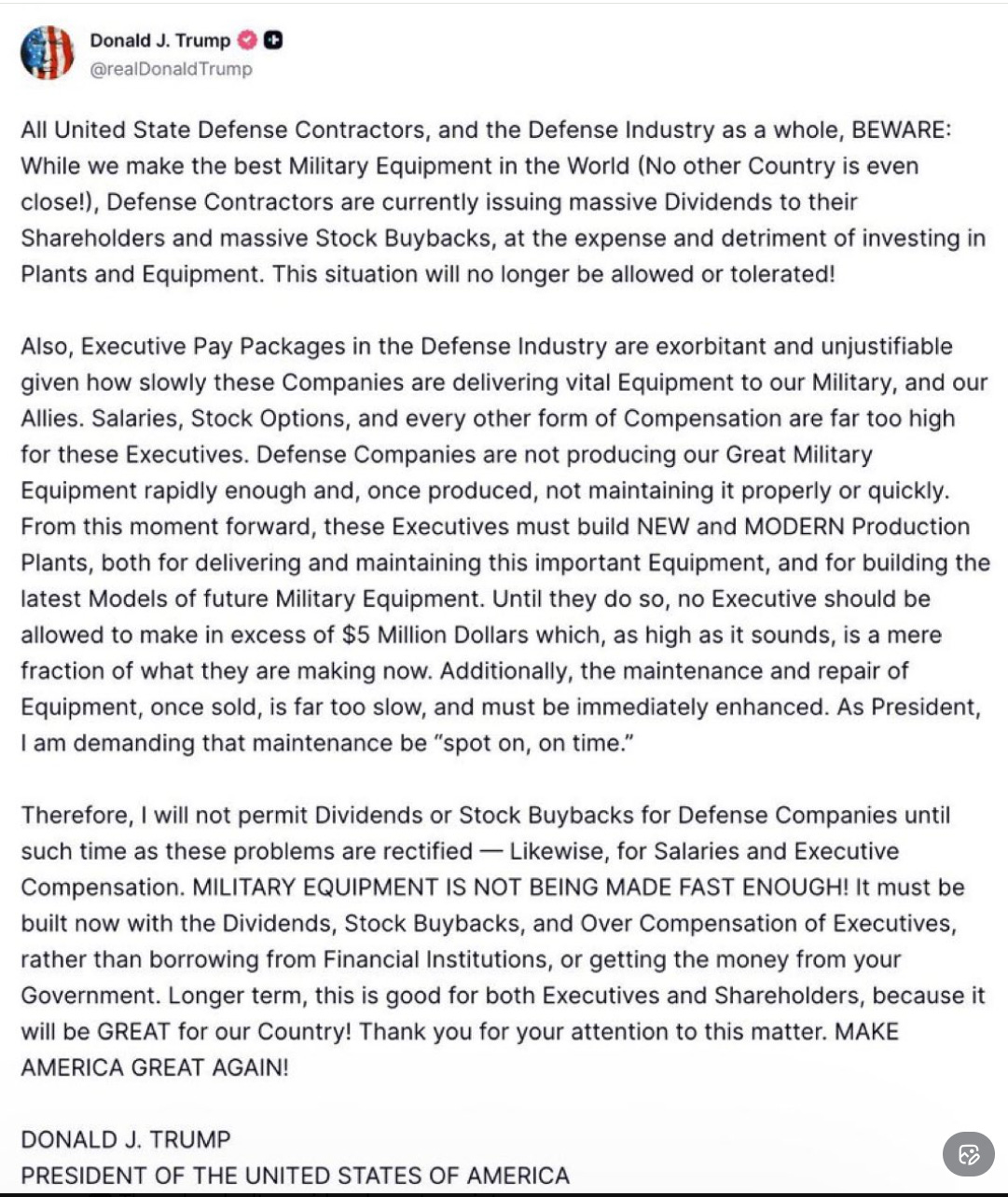
What’s happening here (beneath the rhetoric)
Defence firms are being told they exist to deliver operational capacity fast not to optimize shareholder extraction.
Three system levers being pulled
1. Capital allocation is being re-directed (explicitly)
This is the most important line:
“I will not permit Dividends or Stock Buybacks… until these problems are rectified.”
That’s a direct challenge to:
Financialized defence primes
Buyback-driven valuation models
Executive compensation structures optimized for quarterly optics
System effect:
Capital must flow into plants, tooling, workforce, maintenance, and throughput, not financial engineering.
This aligns with:
Arsenal-of-democracy logic
Wartime production thinking
Long-cycle industrial resilience
2. Speed + sustainment > exquisite platforms
The emphasis is not “better weapons” — it’s:
Speed of delivery
Maintenance on time
Production scalability
Modern plants
This is a shift from:
“We build the best thing eventually”
to
“We build good enough things now, at scale, and keep them running.”
That mirrors what current conflicts (Ukraine, Israel, Red Sea, Taiwan scenarios) are teaching.
3. Executive authority is being subordinated to delivery outcomes
The $5M executive cap (whether symbolic or real) signals this:
Legitimacy comes from delivery.
Executives are being reframed as:
Industrial operators
Capability stewards
Throughput enablers
Why this matters beyond the United States
This posture will not stay contained.
U.S. procurement logic propagates through:
NATO standards
Allied supply chains
Platform interoperability
Sustainment expectations
Systems optimized for:
Governance
Risk avoidance
Paper compliance
will struggle in an environment that prioritizes:
Speed
Surge
Industrial depth
Maintenance realism
This creates immediate pressure on allies whose defence systems are not built for tempo.
The uncomfortable translation
When leaders say “modernization,” what they mean here is not digital dashboards or innovation labs.
They mean:
Faster manufacturing cycles
Predictive maintenance
Workforce augmentation
Integrated toolchains
Industrial command-and-control
This is not about AI as a product.
It is about AI as an industrial coordination layer.
Why this matters now
Many Western defence innovation efforts still assume the industrial system is fundamentally stable and only needs better tools layered on top.
This signal says the opposite.
What is happening here is not an imitation of Eastern industrial defence models but a forced correction inside the Western system. The U.S. defense industrial base is being pulled back toward a production-first, wartime industrial logic that had been progressively financialized and hollowed out.
The industrial system is now being re-shaped under stress, in real time, and in public view.
That guarantees:
Friction
Resistance
Transitional failure
Institutional lag
Which is where operational, systems-lens thinking become essential.
This shift produces a global defence environment that is more constrained by reality and less buffered by assumption.
Defence systems that were built for stability, process, and optimization struggle when pressure becomes continuous rather than episodic. In contrast, systems that can produce, sustain, repair, and adapt under strain accumulate advantage, even without headline dominance.
Over time, this reshapes how power is recognized. Strategy becomes narrower and more conservative, bounded by what industry can actually deliver. Conflict becomes harder to resolve quickly and easier to prolong. Credibility is no longer inferred from intent or alignment, but from demonstrated performance under stress.
Alliances thin out around capability rather than consensus, and credibility is no longer assumed; it is demonstrated continuously.