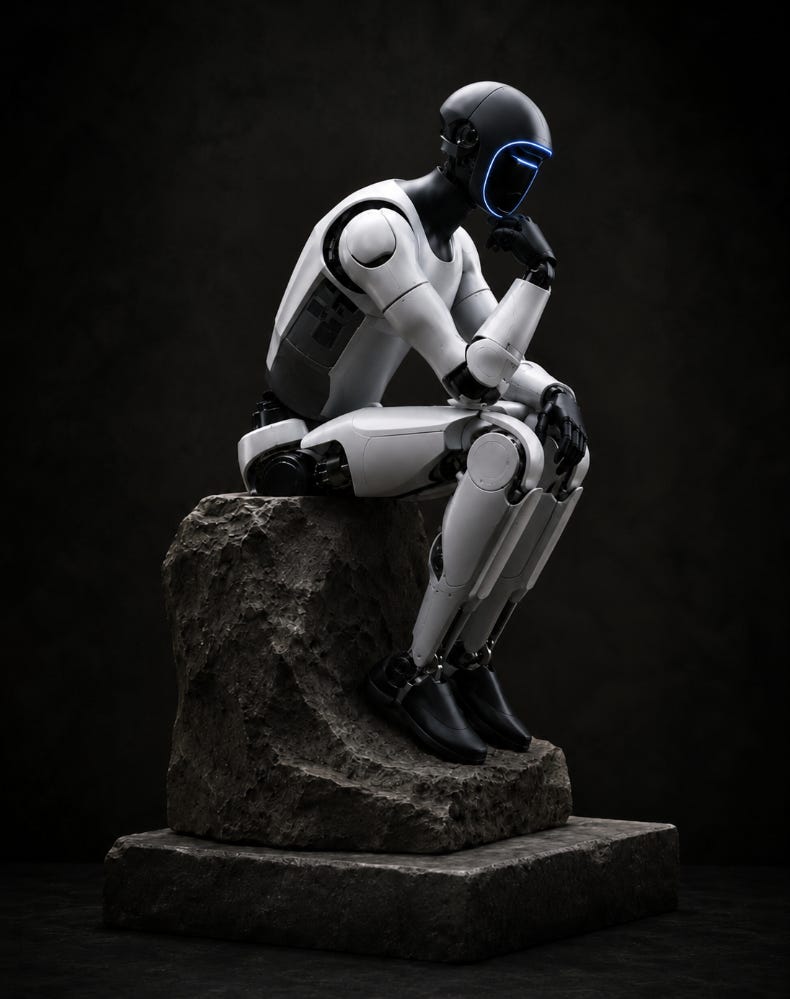
Working with machines is making thinking more visible.
Most human thinking happens too fast to inspect. We jump from instinct to opinion to action. We defend positions before we understand the frame we are using. We confuse familiarity with truth. We let hierarchy, anxiety, status, language, fatigue, and social cues shape what we are willing to say.
When you work with AI closely, you start to see cognition as a system.
You see pattern recognition.
You see overreach.
You see framing errors.
You see how a question changes the quality of an answer.
You see how language pulls thought in one direction or another.
You see how quickly a system can produce something plausible and still miss the point.
And then the bigger realization is that humans do this too.
We also generate plausible answers.
We also overfit to the last thing we heard.
We mirror the room.
We reach for familiar templates.
We also produce “AI slop” in human form like phrases, assumptions, meeting behaviours, doctrine language, strategy clichés, social scripts.
The machine becomes a mirror for human cognition.
What becomes possible
The leap is that humans can begin to watch thinking happen.
Once people can observe their own reasoning patterns, they can start to change them. This is the shift you start to make when you work with machines, a lot.
Not faster writing.
Not better summaries.
Not automation.
A different kind of human capability.
A human who can work with machines well can begin to separate:
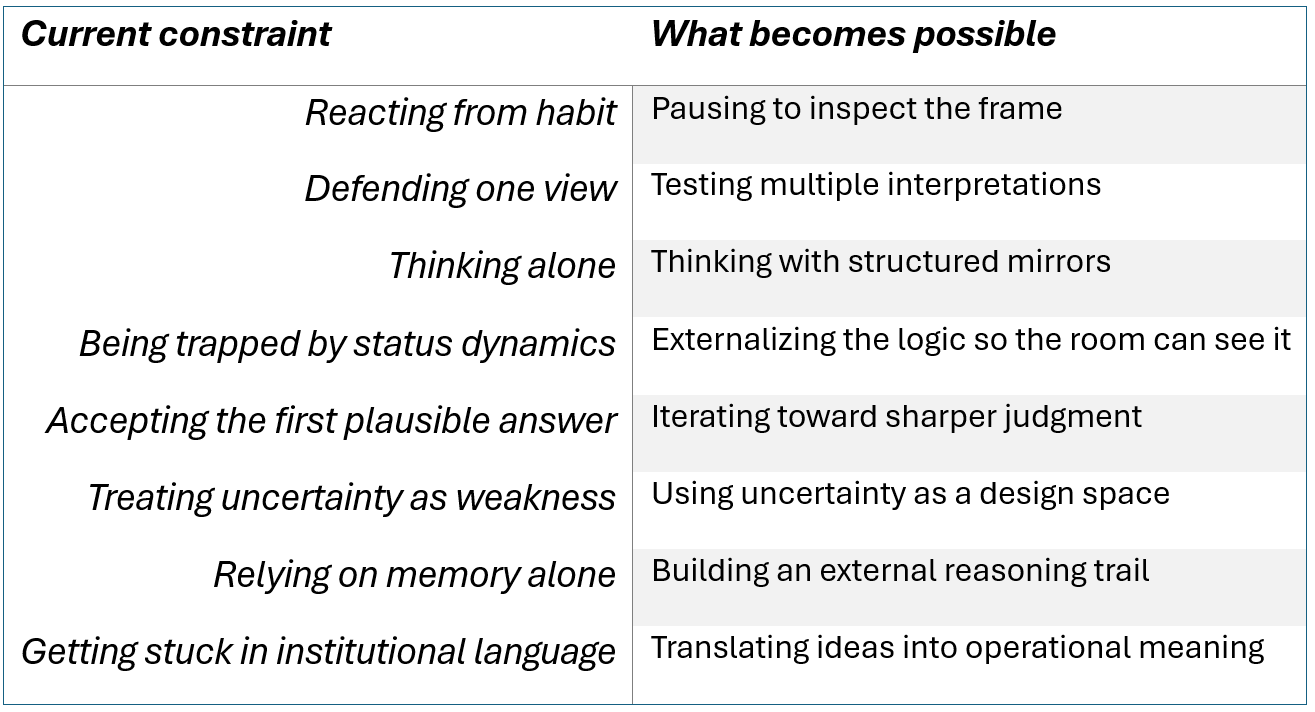
That is not just productivity. It is cognitive expansion.
What it looks like in practice
It looks like people becoming more aware of the gap between what they think and how they think.
A leader walks into a meeting and does not ask, “What is the recommendation?” They ask, “What assumptions are we carrying? What pattern are we repeating? What alternative futures are we refusing to see because they threaten the current structure?”
An analyst does not just produce a report. They can show the logic trail, the evidence, the uncertainty, the competing interpretations, and the decision points.
A strategist does not just write about the future. They can simulate how different actors may reason, misread signals, protect interests, or adapt under pressure.
A team does not just brainstorm. It can use AI to surface hidden assumptions, role-play opposing views, test weak signals, compare narratives, and expose where language has become detached from reality.
A person does not just become “better at AI.” They become better at thinking with reflection, contrast, evidence, and perspective mobility.
A very different skill.
The human upgrade is in metacognition
Thinking about thinking.
But the phrase is very academic. So let’s try this:
You stop being inside your first thought.
You can step outside it.
You ask:
Where did that thought come from?
Is this my view, or the room’s view?
Am I responding to the actual problem, or to the social pressure around it?
What would I see if I were less defensive?
What would someone from another discipline notice?
What would the future version of this system reveal?
Humans move from having thoughts to working with thought as material.
Applied to strategic foresight
Where foresight becomes more powerful.
Foresight is not just about predicting external change. It is about changing the way people perceive reality before the system forces them to.
AI can help reveal the thinking patterns people are using. It can show where imagination is thin. It can expose where a strategy is trapped in old categories. It can help people rehearse futures before they arrive.
The constraint is not usually lack of information.
The constraint is that people cannot yet imagine what the information means.
We are not just using AI to produce content. We are using it to study cognition, narrative, institutional behaviour, resistance, imagination, and adaptation.
The risk
There is a bad version of this.
The bad version is that humans outsource thinking and become more passive. They let the machine produce language, then mistake the language for judgment. They become more dependent, more generic, more easily shaped.
The better version is different.
The machine handles some of the cognitive load so the human can move up a level.
from content to judgment,
from reaction to reflection,
from answer production to sensemaking,
from individual intelligence to collective intelligence.
The future human
A human who moves past current thinking constraints does not become machine-like.
They become more human in a higher-resolution way.
More aware of bias.
More able to hold complexity.
More capable of seeing from multiple positions.
More disciplined with evidence.
More imaginative without becoming vague.
More emotionally regulated under uncertainty.
More able to work across systems, not just inside one role.
Not artificial intelligence replacing human intelligence.
Artificial intelligence making human intelligence observable, trainable, and expandable.