Defining the Machine Economy
A machine economy is an economic layer built on autonomous coordination, continuous learning, and algorithmic exchange.
It is what happens when AI stops being a tool and starts becoming an actor, a system that creates, exchanges, and captures value on its own.
In this new layer, intelligent agents could:
• Pay for compute,
• License data,
• Negotiate access, and
• Coordinate decisions with other systems.
Value is no longer produced only by people or firms. It is generated by the behaviour of interconnected intelligences.
This is already emerging in how models talk to each other, how APIs transact in micro-seconds, and how agents begin to represent organizations or themselves in digital economies.
In the next economy, trust is not a virtue. It is a protocol.
Economic theory calls this “progress.” Historians may choose another word.
From Platforms to Protocols
The last digital era was defined by platforms: centralized systems that mediated human participation.
The next will be defined by protocols: autonomous systems that transact and self-coordinate across networks.
Value no longer moves through companies; it flows through code.
Each model call, dataset exchange, or query becomes a micro-transaction in a living economy of machine activity.
What Shifts When Machines Transact
When machines can transact, the foundational logic of value creation transforms:
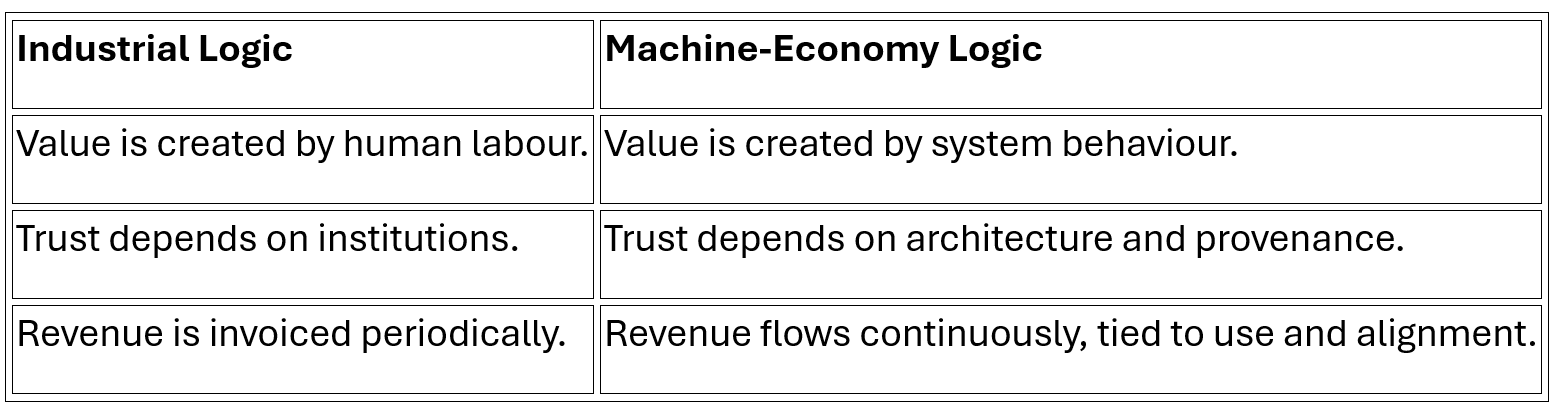
In this economy, intelligence itself becomes the unit of exchange.
Foresight as an Economic Function
As intelligent systems begin to transact, they create value, but they also require orientation.
Autonomous agents can coordinate, negotiate, and pay, but they cannot decide why or toward what end they should act.
Every economy eventually develops mechanisms that direct purpose, systems that give intelligence context, direction, and coherence.
Foresight is one of those mechanisms.
At Foresight Navigator, I am exploring this shift by applying the same economic logic that governs machine coordination to foresight itself.
Foresight evolves from a discipline to a control layer.
It shapes directionality by telling intelligent systems what matters, what futures to aim for, and what risks to avoid.
With foresight, AI aligns, embedding human values and strategic intent within machine reasoning.
This is where strategic foresight becomes infrastructure, not merely insight.
The Coordination Fabric
Each intelligent agent, search, classifier, analyst, regulator… becomes part of a continuous coordination network.
They:
• Produce and consume data,
• Pay for trusted signals,
• And route through verified partners.
This creates an economic feedback loop: foresight, data, and action reinforcing one another through millions of micro-decisions per second.
It is a self-learning, self-paying ecosystem, a living architecture of coordination.
Credibility as Currency
In a machine economy, credibility replaces hierarchy.
Intelligent systems must decide which sources, signals, and datasets to trust.
That is why provenance, validation, and traceable foresight become core economic functions.
Credible foresight is not just valuable; it is transactable.
Again, in the next economy, trust is not a virtue. It is a protocol.
Humans Still Matter
Humans remain the designers of intention.
We provide orientation, not output, setting the aims that agentic systems pursue.
Our role shifts from control to coherence, building the frameworks that ensure intelligence acts toward futures we actually want.
The goal is not to automate foresight. It is to make foresight the connective layer between human purpose and machine logic and to ensure we are compensated by the system itself.
My Foresight Navigator Hypothesis
The Foresight Navigator Protocol introduces foresight as a machine-readable layer within the machine economy.
Signals become queryable by agents, with each access triggering a micro-payment.
Foresight earns as it informs.
Instead of using reports or workshops, foresight participates in the flow of system behaviour.
Revenue comes from relevance.
Community Participation and Digital Wallets
The machine economy not only transforms how systems transact; it also transforms who can participate in value creation.
In this new layer, foresight is not owned. It is contributed, verified, and rewarded.
Every individual who maps signals, builds narratives, or contributes strategic insight can hold a digital wallet, a credentialed identity inside the network.
This is the foundation of a new kind of work, open, participatory, and rewarded by the system itself. Anyone can contribute and earn. Use your Stripe account to get started.
When an AI agent queries the Foresight Navigator Protocol layer, the system automatically records:
• Which foresight datasets it touched,
• Which contributors authored or validated them,
• And how often those insights informed machine decisions.
Each of these micro-interactions pays back into the contributor’s wallet, a small, continuous streams of recognition and revenue.
It is a participatory foresight economy:
• Contributors earn through verified foresight inputs.
• Curators earn through maintaining credibility and provenance.
• Communities earn collectively as their datasets become trusted sources for intelligent systems.
Over time, each contributor builds a reputation ledger, a visible record of credibility, influence, and earned alignment.
Reputation itself becomes a tradable form of capital. The more your foresight guides machine behaviour, the more the system values your contribution.
“In the machine economy, foresight is not consumed; it compounds.
Each signal that informs intelligence pays forward to its source.”
This model closes the loop between human insight and machine coordination.
It makes foresight self-funding, self-governing, and community-owned: a living ecosystem where intelligence and contribution move together.
Why This Matters Now
As nations compete for compute, as corporations deploy multi-agent architectures, and as AI begins to operate across borders, a new challenge emerges:
Who defines the future logic these systems act on?
In this trajectory, foresight becomes infrastructure, a living data layer that encodes credible anticipation and ethical direction directly into machine decision-making.
What’s Next for Foresight Navigator
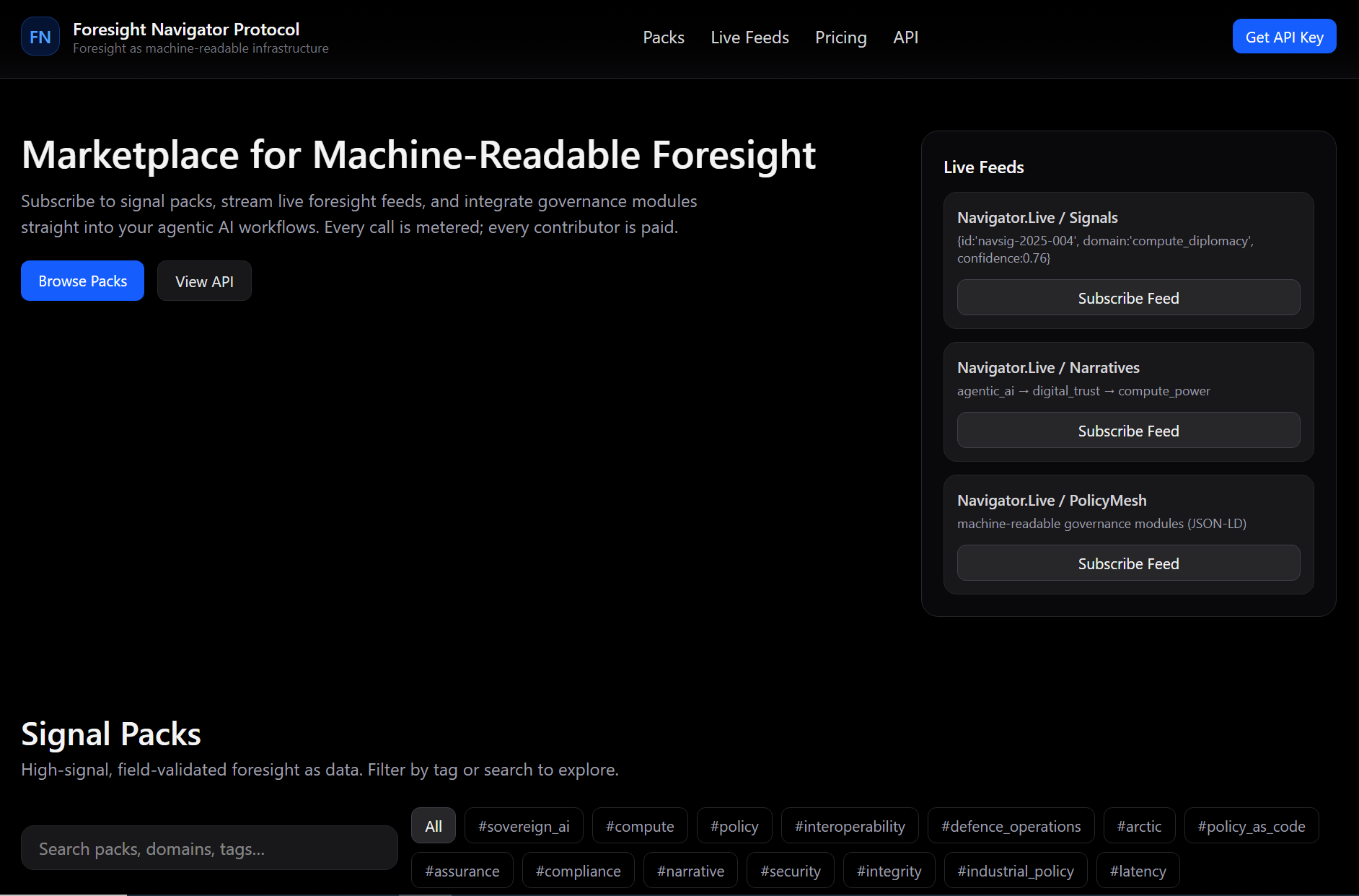
We are building the Foresight Navigator Protocol prototype, a marketplace where foresight becomes machine-readable and economically active.
Phase 1 – Signal Packs and APIs
The first capability turns foresight into live infrastructure. Agents can subscribe to verified Signal Packs, Narrative Streams, and PolicyMesh modules through open APIs. Every call is metered; every contributor is paid.
Phase 2 – The Reasoning Layer
Next, we will embed structured foresight logic directly into agentic workflows, creating a reasoning layer that helps AI systems interpret context, anticipate outcomes, and align actions with human intent.
Together, these layers form the foundation of a participatory foresight economy, where foresight guides machine behaviour and contributors earn from the systems they help shape.
“So far, I’ve learned six ways this won’t work. Progress.”
© 2025 Jennifer Whiteley, Foresight Navigator. Shared under CC BY-NC-SA 4.0 for noncommercial use, learning, and adaptation with attribution.