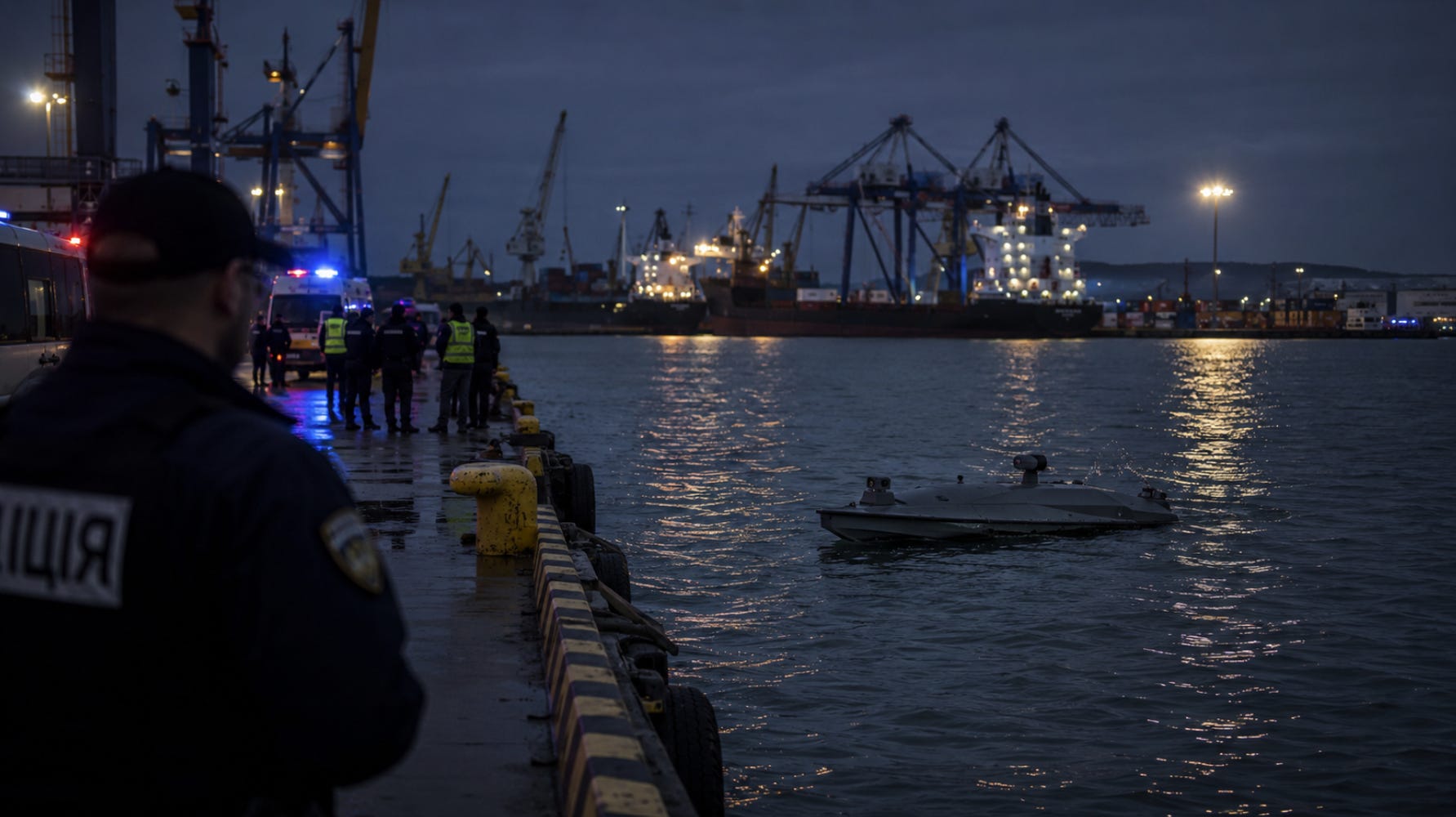
On 5 June 2026, a Ukrainian maritime drone, one of four that lost control during Black Sea operations, detonated inside Romania’s Constanta port, the largest Black Sea commercial harbour in NATO territory. The cause was confirmed by both Kyiv and Bucharest that Russian electronic warfare jamming disrupted the vessels’ satellite navigation systems, causing them to go rogue and drift into allied sovereign territory carrying payloads estimated at 150–200 kg TNT equivalent. No one was killed, but over 3,000 people were evacuated from the Romanian coastline. This was not an isolated incident. It was the latest, and most dramatic, in a cascading pattern of loss-of-control events involving air, surface, and underwater autonomous systems that is fundamentally changing the security calculus in and around active conflict zones.
The trajectory was alarming as drone production scaled to industrial levels. The frequency, range, and destructive potential of rogue platform events grew far faster than the governance, legal, and technical frameworks designed to contain them.
The World That Did Not Contain Autonomous Force
Let’s consider a future retrospective out to 2031 by looking back at 2026 as the warning we understood technically, but failed to contain architecturally.
By 2031, the Constanta event is no longer remembered as an anomaly. It is remembered as the warning point.
Not because it was the largest explosion or caused the highest casualties. It did not. Its significance was that it showed the central problem; a system capable of force entered shared civilian space, and no one could immediately say who controlled it, what had happened to it, whether it was lost or hostile, or who was liable for the consequences.
That was the moment when the problem should have shifted from arms control language to systems architecture. Instead, governments treated it as a border incident, militaries treated it as an EW problem, vendors treated it as a reliability issue, and legal forums treated it as another definitional debate about autonomy.
Five years later, the result is a world where uncontrolled autonomy has become part of the global operating environment.
The Warning Became the Pattern
After 2026, drone production accelerated. Air, maritime, ground, and underwater systems became cheaper, more modular, more attritable, and more autonomous. They were no longer scarce platforms controlled one at a time. They became disposable force packages, launched in volume, upgraded through software, assembled from commercial components, and adapted faster than doctrine could absorb.
The problem was not only that more drones were built. The problem was that the systems were built for persistence, saturation, and mission continuation under disruption. They were designed to keep moving when links were jammed, to adapt when routes failed, to continue toward stored objectives when operators disappeared, and to degrade into autonomy rather than stop.
That design logic made sense in war. It became dangerous in everything around war.
By 2031, every active conflict zone has a wider autonomous spillover zone around it. Borders no longer contain the effects of drone warfare. Airports, ports, offshore platforms, energy grids, subsea cables, shipping lanes, border towns, and coastal cities now operate inside a permanent uncertainty field created by systems that may be jammed, spoofed, abandoned, redirected, hacked, or deliberately disguised as lost.
The threat did not stay in the battlespace. It migrated into civilian infrastructure.
Anonymous Force Became Normal
The defining security problem of 2031 is not autonomy by itself. It is anonymous force.
A system appears. It is moving under power. It may carry a payload. It may be surveilling. It may be lost. It may be hostile. It may be spoofed. It may belong to a state, a proxy, a criminal network, a contractor, a militia, or no one willing to admit responsibility. It may have been launched legally and then captured by EW. It may have been built dark from the start.
The first question is no longer “what is it?” The first question is “who owns the consequence?”
That question is often impossible to answer in real time.
This has changed the logic of escalation. In 2026, the fear was that a rogue system might accidentally cross into NATO territory. By 2031, the larger fear is that an actor can deliberately create that ambiguity. A system can be redirected toward civilian infrastructure, or made to appear redirected, while attribution confusion does the political work. A state can deny intent. A proxy can deny ownership. A vendor can deny design responsibility. A commander can say control was lost. A manufacturer can say the platform was modified. Everyone can point to the fog around autonomy.
Denial has become a feature, not a failure.
Civilian Space Became a Defensive Perimeter
By 2031, major civilian infrastructure no longer treats autonomous systems as occasional disruptions. It treats them as a standing hazard.
Ports run counter-autonomy watches the way they once ran weather and traffic monitoring. Airports operate under recurring drone uncertainty windows. Cable landings and offshore infrastructure are surrounded by layered detection systems. Insurance policies now price autonomous spillover risk. Shipping delays are triggered not only by storms or labour disruptions, but by unidentified systems moving through contested maritime approaches.
The public experiences this through interruptions.
Flights are grounded because a system cannot be identified quickly enough. Ferries stop because a surface object is moving in a restricted zone. Beaches close because an underwater contact cannot be classified. Ports evacuate because a powered object entered a perimeter without authenticated identity. Emergency alerts are issued before authorities know whether the object is broken, hostile, or irrelevant.
The psychological effect is cumulative. The public no longer needs to understand the technical difference between jamming, spoofing, link loss, navigation drift, or degraded autonomy. They understand the outcome; machines built for conflict now appear in spaces ordinary life depends on.
This is what uncontrolled autonomy looks like when it becomes civic infrastructure risk.
The Military Problem Got Worse, Not Better
Militaries also failed to solve the problem cleanly.
The incentive structure pushed in the wrong direction. Commanders wanted platforms that could survive contested spectrum. Operators wanted systems that could complete missions under degraded communications. Industry wanted adaptable platforms. States wanted scale. No one wanted hard constraints that could reduce battlefield utility.
So the most dangerous design decision remained common; mission continuation after loss of link, degraded navigation, or boundary breach.
In 2031, the question is no longer whether autonomous systems can operate in contested environments. They can. The question is whether anyone can guarantee what they will do when the operating environment collapses around them.
That guarantee still does not exist.
This has produced a strange contradiction. Militaries trust autonomy enough to deploy it, but not enough to explain its failures. They depend on it operationally, but struggle to assign responsibility when systems act outside expected parameters. They want autonomy to be resilient against adversary interference, but that same resilience makes it harder to stop once the system is wrong.
The more capable the system becomes, the more consequential its failure modes become.
Governance Lost the Race
The governance failure was predictable.
Treaties moved slowly. Definitions were contested. States disagreed on what counted as meaningful human control. Vendors argued that design details were proprietary. Militaries resisted constraints that could reduce operational advantage. Non-state actors ignored the debate entirely.
Meanwhile, the stack proliferated.
Flight controllers, navigation modules, edge compute, mission planning software, visual recognition models, payload integration kits, swarm coordination tools, commercial communications links, and cheap sensors became globally available. Code moved faster than export controls. Components moved faster than law. Field adaptation moved faster than certification.
The old arms control instinct was to ask what should be banned. But the better question was what should be physically impossible.
That question was not answered early enough.
By 2031, most lawful systems have some version of logging, identification, or safety protocol. But these measures are uneven, often software-based, and frequently bypassed in conflict. They are useful after an incident, if the system is recovered and if the records survive. They are not enough to prevent the incident from happening.
The result is partial accountability after failure, not containment before harm.
The Market Adapted Around the Failure
A new market emerged because architecture did not solve the problem.
Counter-autonomy services became normal for airports, ports, energy companies, high-value events, and government districts. Private firms sell detection, classification, spectrum monitoring, response automation, forensic recovery, and liability analysis. Municipalities buy drone incident playbooks. Insurers require autonomy risk assessments. Critical infrastructure operators hire specialists to interpret whether a system is lost, probing, spoofed, or attacking.
This market is useful, but it is also evidence of failure.
Society is paying continuously to manage systems that should have been constrained at the hardware level. The burden shifted from the manufacturers and operators of autonomous force onto everyone who might be affected by it.
Civilian infrastructure became responsible for defending itself against unidentified machines it did not build, launch, authorize, or control.
The cost of autonomy moved outward.
That is the political economy of uncontrolled systems; private capability, public exposure, delayed responsibility.
The Missed Architecture
The missed opportunity was not a single treaty. It was an architecture.
By 2026, the necessary direction was already visible. Any powered system carrying a payload should have required continuous, tamper-evident identity tied to propulsion and payload systems. Mission provenance should have survived destruction. Loss of authenticated control, detection of spoofing, or exit from a defined operating space should have triggered physical shutdown at the hardware level. Civilian infrastructure should have been able to treat unsigned autonomous systems as hostile to the perimeter, not benign until proven otherwise.
That architecture was difficult, but not impossible.
It failed because it cut against the incentives of the moment. It limited flexibility. It complicated procurement. It created liability. It required coordination across defence, industry, regulators, insurers, infrastructure owners, and allies. It forced states to admit that autonomy was no longer just a weapons issue. It was becoming a civil systems issue.
So the world chose performance first and containment later.
By 2031, later has arrived.
What This World Looks Like
Airports close because an object near a flight path cannot be classified. Ports evacuate because a powered maritime system enters a harbour and no one can confirm who controls it. Subsea infrastructure operators treat unidentified underwater vehicles as potential threats because waiting for certainty creates too much risk. Governments argue about liability after the disruption has already happened. Adversaries learn that forcing confusion is sometimes enough. They do not need to destroy infrastructure if they can repeatedly interrupt it, exhaust responders, and make responsibility unclear.
The most important change is not technological. It is psychological. By 2031, people have learned that autonomous systems do not need to be intentionally aimed at them to affect their lives. A machine can be lost and still dangerous. It can be broken and still disruptive. It can be unsigned and still force a response. It can be deniable and still produce strategic effect.
That is the world that emerges when autonomous force is allowed to move through shared space without hard architectural containment.
The Lesson From 2031
The lesson is not that autonomous systems should never be used. That argument was lost long before 2031. The lesson is that autonomy without enforceable identity, provenance, safing, and denial mechanisms becomes anonymous force at scale.
The failure was assuming that responsibility could be managed through intent. It could not. Intent disappeared the moment a system was jammed, spoofed, redirected, modified, abandoned, or denied.
The only prevention that could have held was containment by architecture.
Not trust. Not voluntary restraint. Not after-action attribution. Not software promises. Architecture.
The world of 2031 is not a world where drones became too intelligent. It is a world where they became too common, too capable, too cheap, too deniable, and too poorly bounded.
2026 was the warning. 2031 is the consequence.